
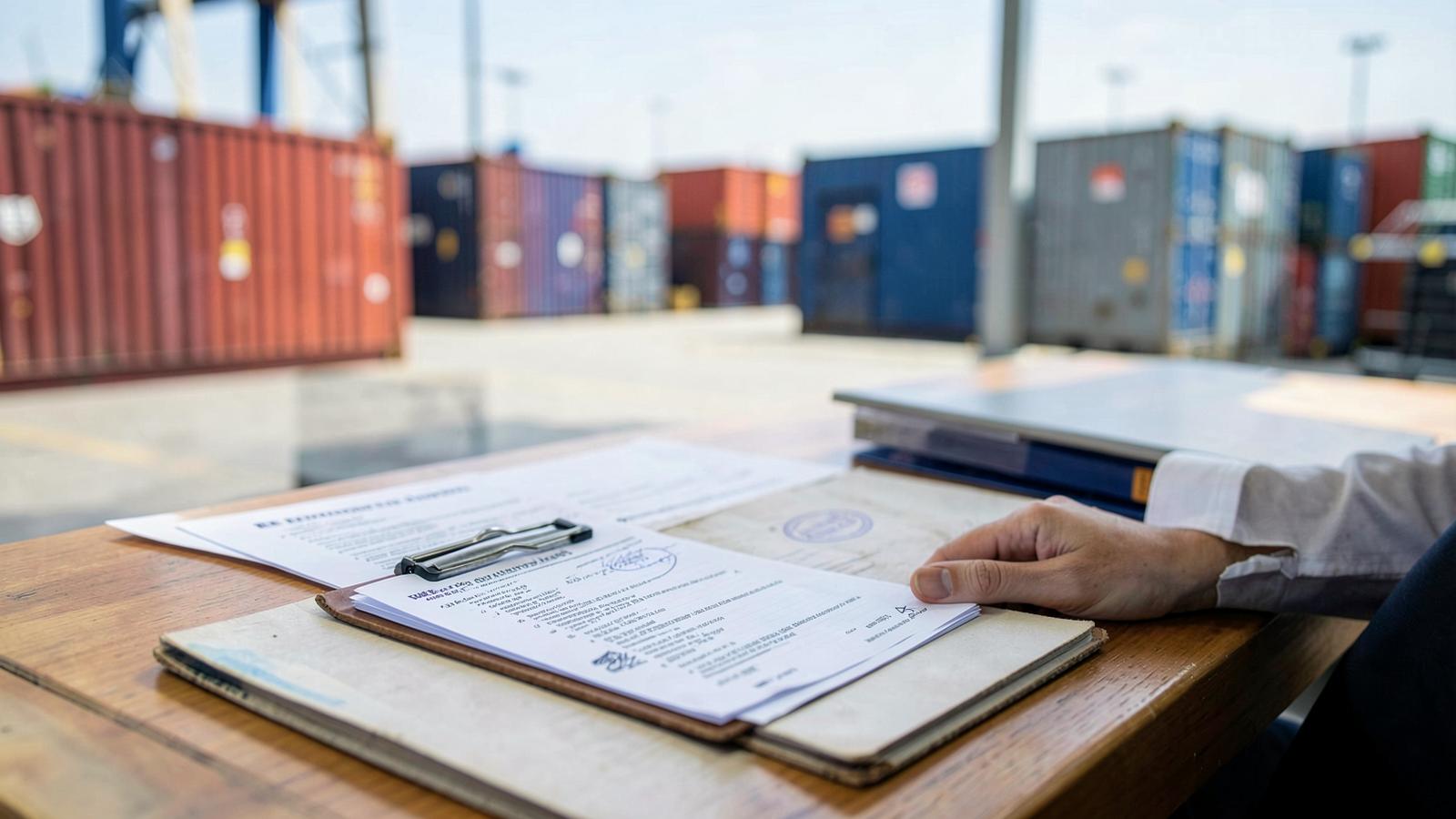
What customs documents does a foreign brand need for its first US shipment?
A foreign brand needs eight core items before its first US shipment: an Importer of Record designation, an EIN and a customs bond, a commercial invoice with packing list, a certificate of origin where preferential duty is claimed, any product-specific certifications required by FDA, FCC or CPSC, a correct Harmonized Tariff Schedule classification with duty calculation, an Importer Security Filing for ocean freight filed 24 hours before loading, and bonded warehouse or Foreign Trade Zone documentation where duty deferral applies.
By the Seal Global Holdings Advisory Team, US Market Entry Practice · Published September 3, 2026. Our logistics team has cleared first shipments for international consumer, industrial and medical brands through US ports for more than two decades, and manages the brokers and bonds behind them.
Most first US shipments are not delayed by freight. They are delayed by paperwork that was prepared by someone who had never shipped into the United States, reviewed by nobody, and discovered to be wrong when the container was already on the water. The documents themselves are not complicated. What causes trouble is that they are issued by different parties, on different timelines, and each one depends on a decision made earlier in the chain.
This is a documentation checklist, not an operations guide. It does not cover selecting a warehouse or a 3PL, which is a separate exercise covered in our US 3PL and warehouse setup checklist. It covers the eight items that have to exist, correctly, before your goods can legally enter US commerce.
What Is US Customs Compliance Documentation?
US customs compliance documentation is the set of legal filings and commercial records that US Customs and Border Protection, and any partner government agency with jurisdiction over the product, require before imported goods may be released into US commerce. It identifies the party legally responsible for the entry, establishes the classification, value and origin of the goods, and provides financial security for the duty owed. Incomplete or inaccurate documentation, rather than the goods themselves, is the most common cause of a customs hold.
The Eight Documents at a Glance
| Document | Purpose | Who issues or prepares it | Typical lead time |
|---|---|---|---|
| 1. Importer of Record designation | Names the party legally liable for the entry and the duty | Importer, via CBP Form 5106 and a power of attorney to the broker | 1–2 weeks |
| 2. EIN and customs bond | Tax identification and financial security for duties owed | IRS issues the EIN; a surety issues the bond through the broker | EIN 2–5 weeks; bond 3–5 days after underwriting |
| 3. Commercial invoice and packing list | Establishes parties, description, value and terms of sale for duty assessment | Exporter or seller, reviewed by the importer | Before departure |
| 4. Certificate of origin | Supports a preferential duty claim under a trade agreement | Exporter, or a chamber of commerce where certification is required | 3–10 days |
| 5. Product-specific certifications | Satisfies FDA, FCC or CPSC requirements for regulated goods | Accredited test laboratory, plus the manufacturer's declaration | 2–12 weeks depending on testing |
| 6. HTS classification and duty calculation | Determines the duty rate and any trade remedy exposure | Importer with the customs broker; binding rulings from CBP | Days internally; ~30 days for a binding ruling |
| 7. Importer Security Filing (ISF) | Advance security data for ocean cargo | Customs broker or forwarder, using data from the importer and supplier | Filed 24+ hours before vessel loading |
| 8. Bonded warehouse / FTZ documentation | Defers or eliminates duty on stored or re-exported goods | Warehouse operator or FTZ grantee, with CBP approval | 4–16 weeks for activation |
1. Importer of Record Designation
Nothing else can be prepared until this is settled, because every subsequent document names the importer of record. The IOR is the party legally responsible for the accuracy of the entry and for paying duty, and Customs pursues it, not the broker, when something is wrong. It must be the owner, the purchaser, or a licensed broker acting under power of attorney, and it must hold a US tax identification number or a Customs-assigned number.
Most brands appoint their US subsidiary, because product liability, sales tax registration and the bank account that pays the duty all sit with the same entity anyway. The alternatives, including foreign IOR numbers and third-party IOR services, are covered in our importer of record requirements guide.
2. EIN and Customs Bond
The EIN comes from the IRS on Form SS-4. For a foreign responsible party without a Social Security Number the application goes by fax or mail and takes roughly two to five weeks, which is why it should be filed the week the entity is formed rather than the month before the container ships.
The customs bond is a surety instrument guaranteeing that duties, taxes and fees will be paid. A single-entry bond covers one shipment; a continuous bond covers twelve months of entries and is cheaper from about four shipments a year, while also satisfying the ISF bond requirement. Surety underwriting for a company with no US credit history can require collateral, so start it early.
3. Commercial Invoice and Packing List
The commercial invoice is what Customs reads to assess duty: parties, description, quantity, unit value, currency, Incoterms and country of origin. The packing list reconciles cartons, weights and dimensions against it. Two errors account for most holds. The first is a description too vague to classify, such as "parts" or "textile goods". The second is a value that does not reconcile to the purchase order, which reads to Customs as a valuation question rather than a typing error.
4. Certificate of Origin
Origin determines whether a preferential duty rate applies and whether the goods fall under any origin-based restriction. Under USMCA the claim is generally made by certification statement rather than a prescribed form, but the supporting records must exist and must survive a verification request years later. Where no preference is claimed, the origin declared on the commercial invoice is usually sufficient. It is still worth calculating the preferential rate before assuming it does not apply, because the duty saving on a full container often exceeds the cost of obtaining the documentation many times over.
5. Product-Specific Certifications
This is the item most likely to be discovered too late, because it depends on the product rather than on the shipment. Food, supplements, cosmetics, medical devices and radiation-emitting products engage the FDA. Anything with a radio or a clock oscillator engages FCC equipment authorisation. Children's products require third-party testing and a Children's Product Certificate under CPSC rules. General consumer goods require a General Certificate of Conformity where a consumer product safety rule applies.
Testing is the long pole. Twelve weeks is not unusual for a device requiring a new FCC authorisation. The determination of which agency touches your product belongs at the purchase-order stage, and it is one of the first things we map in a US operations enablement engagement because it constrains everything downstream.
6. HTS Classification and Duty Calculation
Every line item needs a ten-digit Harmonized Tariff Schedule code. That code sets the duty rate and determines exposure to antidumping, countervailing and Section 301 measures, which frequently dwarf the base rate. Classification is a legal determination, not a lookup, and getting it wrong is expensive in both directions: underpayment attracts duty, interest and penalties within a five-year statute of limitations, while overpayment simply funds the Treasury unless you file for a refund.
Where a product could reasonably fall into two headings, a binding ruling from Customs takes around thirty days and settles the question in writing. Anyone importing at volume should classify with a broker before the first order, then keep the classification file current as the range changes.
7. Importer Security Filing for Ocean Freight
The ISF, known as 10+2, must be filed at least twenty-four hours before the cargo is loaded onto the vessel at the foreign port. Ten data elements come from the importer and two from the carrier, including the manufacturer, the seller, the ship-to party, the container stuffing location and the consolidator. Late, inaccurate or missing filings carry liquidated damages of up to $5,000 each, and Customs can issue a do-not-load instruction at origin, which is worse than the fine.
Air freight has no ISF requirement. The practical difference is that ocean shipments need their documentation complete several days before departure, whereas air shipments can be finalised much closer to wheels-up.
8. Bonded Warehouse and FTZ Documentation
A bonded warehouse allows dutiable goods to be stored for up to five years with duty payable only on withdrawal into US commerce. A Foreign Trade Zone goes further: goods can be stored, manipulated or assembled with duty deferred, eliminated on re-export, and merchandise processing fees reduced through weekly entry. Both require an application, an approved inventory control system and continuing recordkeeping.
Neither is a default. For a brand importing finished goods with fast turns and modest duty rates, the compliance overhead exceeds the saving. Where duty is high, dwell is long, or a meaningful share of inventory is re-exported, the calculation flips. We size that trade-off as part of our US warehousing and customs setup work, and the shorter version is in customs broker vs. 3PL vs. operations enablement partner.
Sequencing the Eight
Order matters more than speed. Settle the importer of record and the EIN first, because the bond and the broker power of attorney depend on both. Classify the range next, because duty exposure changes pricing and sometimes the sourcing decision. Run product certification testing in parallel from day one, since it has the longest lead time. Prepare the commercial documentation and origin evidence against the purchase order rather than after it. File the ISF against a confirmed sailing. Decide on bonded storage last, once you know the duty and the turn rate.
Brands that treat these as one workstream with one owner clear their first container in days. Brands that treat them as eight separate errands discover the dependencies at the port, where storage is billed daily. If the wider first-year build is still open, our market entry and operations enablement team runs entity, banking, customs and fulfillment against a single dated plan, and works alongside the offshore capability teams that many brands use for the ongoing documentation and reconciliation load once volume builds.
Related Services from Seal Global
US Market Entry & Operations Enablement
Entity, customs, warehousing and compliance run as one sequenced programme.
Learn moreUS Warehousing, Logistics & Customs Setup
3PL selection, customs brokerage, FTZ setup and fulfillment network design.
Learn moreTalk to Our US Import Team
A review of your classification, bond and broker arrangements before the first container.
Learn moreImporter of Record Requirements
Who can be your IOR and what liability comes with it.
Learn moreCustoms Broker vs. 3PL vs. Operations Partner
Who does what when you import, and the order to appoint them.
Learn moreUS 3PL & Warehouse Setup Checklist
The operational setup that runs alongside the paperwork.
Learn moreFrequently asked questions
17 answers about us customs documents.
1. Documentation Basics
2. Customs Process & Timing
3. Costs & Bonds
4. Working with Brokers & 3PLs
Get the paperwork right before the container sails
We appoint the broker, set the classification, post the bond and sequence the entry against your warehouse receiving slot.
Talk to our import team