
Do Google AI Overviews actually reduce website clicks?
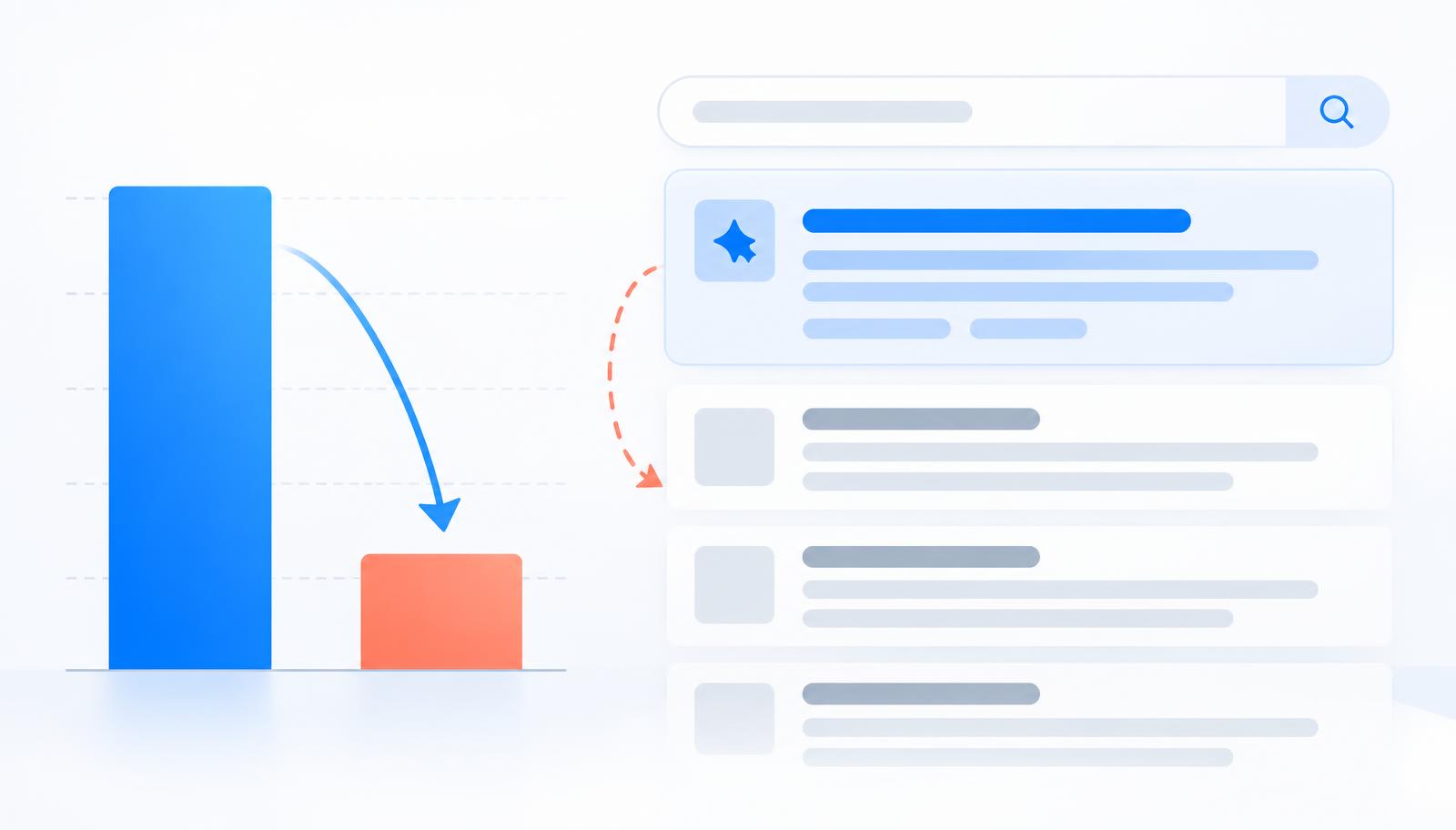
Yes, measurably. A Pew Research study of 68,879 real Google searches found click-through rates drop from 15% to 8%, about a 47% relative decrease, when an AI Overview appears on the results page. AI Overviews show up on roughly 18% of all searches, more often on longer and question-phrased queries, and Google disputes the study's methodology while citing a separate 10% increase in overall query volume.
A client asks almost every week now: is Google's AI Overview quietly killing our organic traffic? The honest answer, backed by the best data available so far, is more specific than a yes or no. AI Overviews measurably reduce the odds that a given search ends in a click, but they don't appear on every search, and Google disputes how much they actually hurt sites in aggregate. Here's what the 2026 data actually shows.
The click-through rate drop, in real numbers
Pew Research Center analyzed 68,879 real Google searches from 900 U.S. adults, collected in March 2025 and published that July. When an AI Overview appeared, only 8% of visits ended in a click to a search result link. When no AI Overview appeared, that number was 15%. That's roughly a 47% relative drop in click-through rate on searches where Google decided to show a summary. Clicking a link inside the AI Overview itself happened even less often, in just 1% of all visits to pages carrying one.
What happens after the click doesn't happen
The same study found users ended their entire browsing session 26% of the time after a search page showed an AI Overview, compared to 16% of the time when it didn't. That gap matters more than the raw click number. It suggests AI Overviews aren't just changing which result gets clicked, they're often closing the loop on the search entirely, with the user getting a usable answer and moving on without visiting any site at all.
Not every search triggers one, and length matters
AI Overviews showed up on about 18% of all searches in the Pew dataset, and 58% of participants encountered at least one during the study period. Query phrasing predicts this closely. Searches of ten words or more triggered an AI Overview 53% of the time, against just 8% for one- or two-word searches. Question-phrased searches triggered one 60% of the time, versus 36% for full sentences that weren't phrased as questions. A typical AI Overview ran about 67 words and cited three or more sources in 88% of cases, with Wikipedia, YouTube, and Reddit together accounting for roughly 15% of the links cited.
Google pushes back on the numbers
Google called Pew's methodology "flawed" with a "skewed queryset," and the company maintains that AI Overviews drive over 10% more queries globally for the search types where they appear, a figure CEO Sundar Pichai has repeated publicly. Both things can be partly true at once: an individual search that shows an AI Overview may be less likely to produce a click, while the total volume of searches Google receives keeps growing. What the two sides don't agree on is whether that growth actually offsets the per-search click loss for the sites whose content gets summarized instead of visited. Independent data on that broader tradeoff is still mixed by industry and query type.
What this actually changes about a content strategy
Ranking first in classic organic results no longer guarantees a click, and it doesn't guarantee AI Overview citation either, since Google draws overview citations from a broader pool of sources than just the top result. What consistently shows up in the data is that AI Overviews favor specific, well-sourced answers to precisely phrased questions over broad or promotional pages, and they trigger more often on the longer, question-style searches that also tend to signal real buying or research intent. That means the practical response isn't to abandon organic content work, it's to apply the same discipline good answer engine optimization already calls for: write directly to the specific question a buyer types, back claims with named data the way a generative engine optimization program should, and track visibility inside AI answers as a second, additional metric next to standard rankings rather than a replacement for them. Tools built for this, like the ones covered on our AI search visibility page, exist because ranking position alone no longer tells the whole story of whether a brand is actually being seen.
This is precisely the tracking gap a one-time report can't close, and it's the work Seal Global's AI search visibility team does month over month for its own clients: running weekly citation checks across ChatGPT, Gemini, and Google's own AI Overviews so a client knows whether a content change actually moved their visibility, not just their rank.
Related Reading
- How ChatGPT, Gemini, and Google AI Overviews Actually Decide What to Cite
- Does Your Brand Actually Need AI Search Optimization, or Is This Hype?
- How to Check Whether Your Brand Shows Up in AI Search
- What Agentic AI and Human-in-the-Loop Workflows Mean for Brand Trust
Sources: Pew Research Center, "Do people click on links in Google AI summaries?"; Search Engine Land, "Google's AI Overviews are hurting clicks: Pew study".
Related services from Seal Global
AI Search Optimization
Ongoing work to keep a brand visible as search shifts toward AI-generated answers.
Learn moreGenerative Engine Optimization
Structuring content so AI engines can find and cite it accurately.
Learn moreAI Search Visibility Tools
Track how often and how accurately a brand appears across AI answer engines.
Learn moreFrequently asked questions
17 answers about how Google AI Overviews affect click-through rates and what to do about it.
1. How AI Overviews Affect Clicks
2. What Triggers an AI Overview
3. Google's Response and What It Means
4. What To Do About It
Track visibility where the click used to be
Find out whether your brand is being cited inside AI answers, not just ranked below them.
Talk to our AI search team