
What should an ecommerce brand have in place before outsourcing operations for peak season?
Before peak season volume hits, a brand needs explicit escalation rules defining what a support team can resolve independently, a live feed of inventory and order data instead of a static spreadsheet, a peak-season version of service levels that accounts for volume multiples rather than average-month numbers, and a documented returns policy a new team member can apply consistently. Because training an outsourcing partner on product knowledge and systems takes six to ten weeks, this groundwork needs to be in place by late September or early October for a November surge, not assembled after volume has already increased.
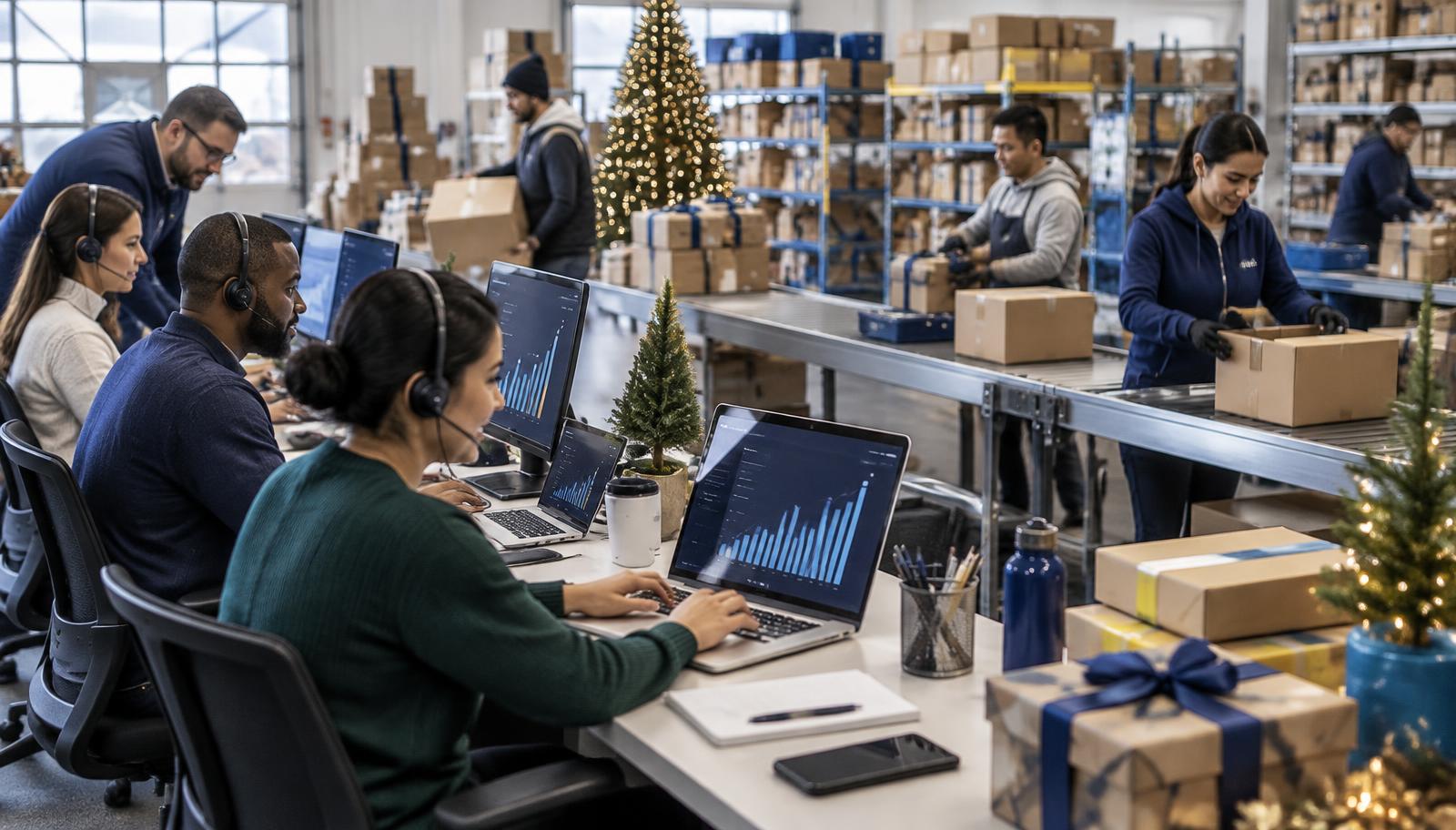
Peak season changes the math on ecommerce operations outsourcing well before the first Black Friday order comes in. eMarketer and Salesforce put total US holiday retail sales at $1.41 trillion this year, up from $1.35 trillion in 2025, with online sales expected to cross $300 billion for the first time. Mobile alone will carry 58 percent of that online volume. None of that growth arrives evenly. It lands in about eight weeks, and most of it concentrates into a handful of days around Thanksgiving.
Support has to absorb the spike without slowing down
The operational strain shows up first in customer support. eDesk's 2026 customer service research found that 38 percent of shoppers now expect an immediate response, and close to a third expect an answer within an hour. Most brands are nowhere near that even outside peak season: the industry average first response time sits at 12 hours and 10 minutes by email, and typical live-support benchmarks run 4 to 6 hours. Best-in-class teams answer in 30 to 60 minutes. During peak season, ticket volume rises at the same time customer patience drops, which turns an already wide gap into a visible one.
Returns arrive as a second, delayed spike
Returns widen the gap further. Industry return-rate research projects 19.3 percent of 2025 online sales will come back, worth roughly $849.9 billion in total US retail returns. Returns do not translate one to one into support tickets, but a commonly cited model puts about 25 percent of returns in contact with support at least once, averaging 1.25 contacts per return that gets touched. Run that against a mid-size store doing 50,000 orders a month and the return-driven contact volume alone lands around 4,200 tickets, on top of the normal order-related volume peak season already adds. It is why 60 percent of retailers report having to choose between processing new orders and handling returns during the surge, and why 49 percent plan to lean on third-party logistics partners and 43 percent on seasonal hires just to keep both moving.
Lead time, not headcount, is the real constraint
None of this is solvable by adding headcount in November. A seasonal hire brought on two weeks before Black Friday has no product knowledge, no access to the systems that matter, and no context on how a brand actually handles an edge case. An outsourcing partner or agency works the same way if it starts cold during the surge: it performs like an undertrained seasonal hire with a bigger invoice. The relationship has to exist, or at minimum be fully staffed and trained, well before the volume hits.
Training a new team, whether internal seasonal hires or an outsourced group, on product knowledge, tone, escalation paths, and system access takes real weeks, not days. Add sourcing and onboarding for an outsourcing partner and the realistic runway stretches to six to ten weeks before volume actually needs the coverage. Starting that process in late October instead of late September is the single most common reason brands end up running peak season understaffed rather than by choice.
What actually has to be in place beforehand
What needs to be ready before that surge starts is less about the partner and more about what a brand hands them. Escalation rules need to be explicit: which issues a support team can resolve on its own, which need an internal decision, and how fast that decision has to come back. Inventory and order data need a live feed rather than a spreadsheet somebody updates once a day, because a support answer built on yesterday's stock count creates a second problem instead of solving the first. Service levels need a peak-season version that accounts for volume multiples, not just the numbers agreed to in a quiet October. Returns policy needs to be written down in enough detail that a support agent who has never spoken to the brand before can apply it consistently on order 4,000 of the week, not just order 40.
The brands that get through peak season cleanly are rarely the ones who scaled hardest. They are the ones who had the documentation, the data feed, and the escalation path settled before volume made all three matter at once.
This is precisely the layer that turns peak-season readiness into an ongoing practice, and it's the work Seal Global's ecommerce team does month over month for its own clients: running support, catalog, and fulfillment coordination as one continuously staffed program instead of a function stitched together each November.
Related Reading
Related Services from Seal Global
Ecommerce Outsourcing Services
Ongoing fulfillment coordination, support, catalog, and marketing execution under one team.
Learn moreEcommerce Customer Support
Dedicated support coverage built to hold response times steady through volume spikes.
Learn moreEcommerce Agency
A coordinated team running execution across support, catalog, and marketing.
Learn moreFrequently asked questions
10 answers about preparing ecommerce support and operations for peak season outsourcing.
1. Timing and Readiness
2. Customer Support During the Surge
3. Returns and Operational Readiness
Want peak season support in place before the surge hits?
See how a coordinated ecommerce outsourcing team runs support, catalog, and fulfillment coordination as one continuously staffed program, not a function assembled each November.
Explore ecommerce outsourcing services