
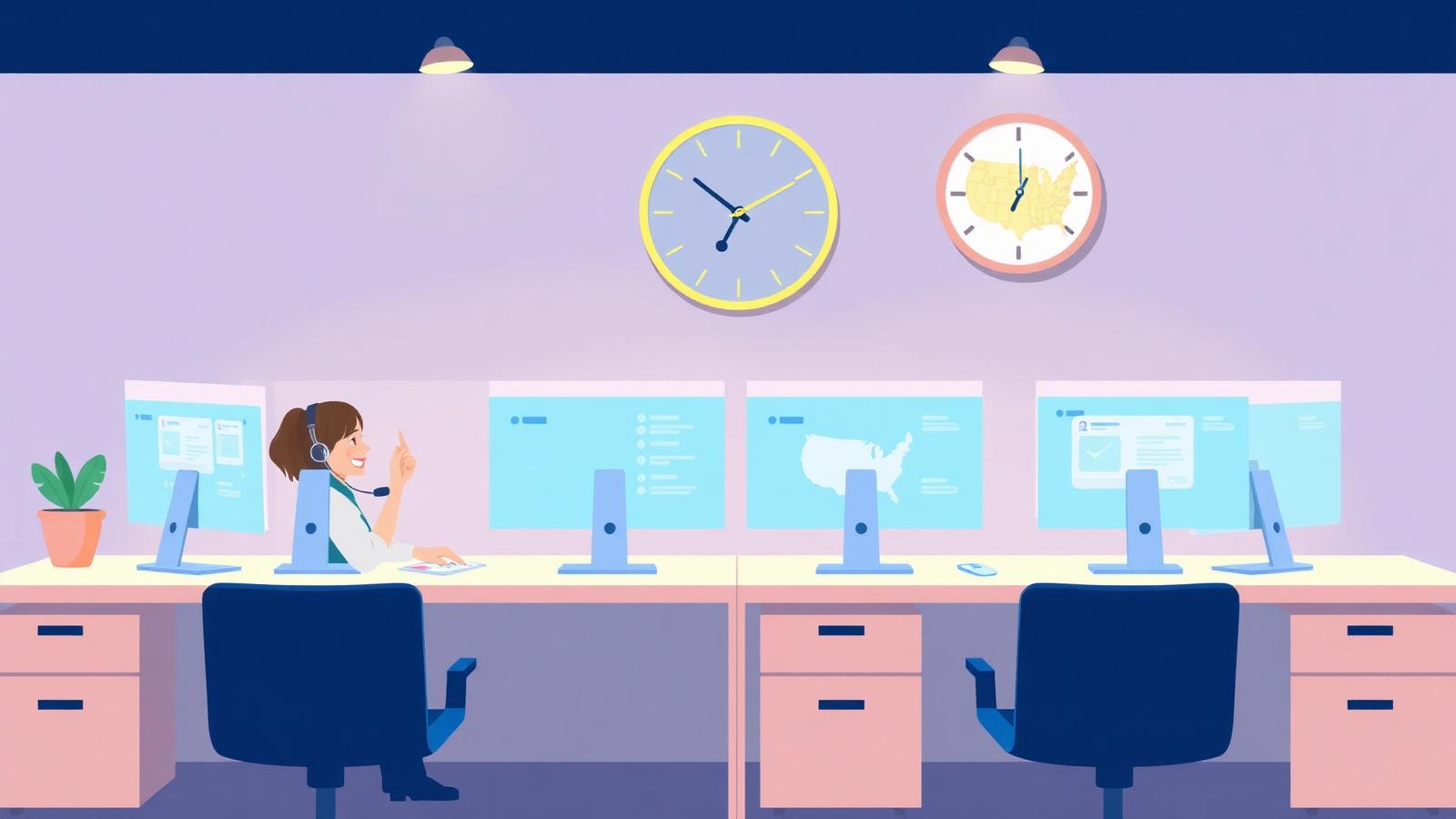
What is US localized customer support outsourcing?
US localized customer support outsourcing is a model where a foreign company serves its American customers through US-based or US-timezone support representatives employed on its behalf — typically via an employer of record (EOR) — while a managed back-office partner handles payroll, HR compliance, training and administration. The company gets native-hour coverage without opening a US office.
By the Seal Global Content & Search Strategy Team · August 24, 2026
Told by the operations team that employed, onboarded and administratively managed the US support team in this engagement. Company details are anonymized at the client’s request.
Nordvik Living (name changed) is a Copenhagen-based direct-to-consumer home goods brand. By early 2026, 60% of its revenue came from US customers buying through its Shopify store — and nearly all of its one- and two-star reviews mentioned the same thing: support that answered a day late. The fix did not require a US office, a US lease, or a US subsidiary. It required four US-based support reps, employed compliantly, working US hours — which is exactly what US market entry operations enablement is built to deliver.
What Is US Localized Customer Support Outsourcing?
What Is US Localized Customer Support Outsourcing? US localized customer support outsourcing is a model where a foreign company serves its American customers through US-based or US-timezone support representatives employed on its behalf — typically via an employer of record (EOR) — while a managed back-office partner handles payroll, HR compliance, training and administration. The company gets native-hour, native-accent coverage without opening a US office or forming a US entity first.
The model sits between two extremes foreign brands usually consider first: hiring US employees directly (which requires a US entity, payroll registration in each work state, benefits administration and an HR function), and staffing a freelance marketplace (which trades away consistency, product knowledge and data control). The EOR-plus-managed-admin structure keeps the reps dedicated to one brand while the employment infrastructure belongs to the partner.
The Problem: Copenhagen Hours, American Customers
Nordvik’s four-person support team worked 9:00–17:00 Central European Time. That window covers 3:00am–11:00am US Eastern — meaning a customer in Chicago who emailed after lunch got a reply the following morning, and a customer in Los Angeles effectively waited two days across a weekend. First response time averaged nine hours. Return-related tickets, the brand’s most sensitive category, were the slowest of all because they needed a human decision rather than a macro.
The founders priced a US office: a small leased space, a US entity upgrade, state payroll registrations, benefits, a local manager. The estimate came back above $400,000 a year before a single ticket was answered — and six months of setup before the first hire started.
The Three Models They Compared
| Criterion | Own US Office + Direct Hires | Freelance Marketplace | EOR + Managed Back-Office |
|---|---|---|---|
| Time to First Rep Live | 4–6 months | Days, with high churn | 3–4 weeks |
| US Entity Required | Yes, plus state payroll registrations | No | No — the EOR is the legal employer |
| Payroll, Benefits & HR Compliance | Built and run in-house | Not applicable — but misclassification risk sits with you | Fully managed by the partner |
| Brand Dedication | Full | Split across clients | Full — reps work only on your brand |
| Year-1 Cost (4 reps) | $400k+ including office and management | Lower hourly, higher hidden cost in quality | Roughly 55–65% below the office model |
What Seal Global Actually Did
The engagement ran through our customer support outsourcing practice on the front line and our EOR infrastructure behind it:
- Role design (week 1). Four US-based generalist reps covering 8:00am–8:00pm Eastern on staggered shifts, plus one team lead. Job profiles written around DTC returns, exchanges and order management.
- Compliant hiring (weeks 2–3). Reps employed through the employer of record — offer letters, I-9 verification, state tax registrations, payroll and benefits all handled without Nordvik forming anything in the US.
- Brand onboarding (weeks 3–4). Product training, tone-of-voice calibration against the Copenhagen team’s best transcripts, and escalation paths for warranty decisions.
- Managed administration (ongoing). Timesheets, scheduling, performance reviews, equipment, HR issues and backfill hiring all run remotely by Seal Global — the “managed administrative services” layer that keeps a foreign founder out of US employment paperwork entirely.
Ninety Days Later: The Numbers
| Metric | Before (Copenhagen Only) | After (US EOR Team) |
|---|---|---|
| First Response Time | 9 hours average | 22 minutes average |
| Live Coverage (US Eastern) | 3:00am–11:00am | 8:00am–8:00pm |
| CSAT | 78% | 94% |
| Return-Related Escalations | Baseline | Down 37% |
| Cost per Resolved Ticket | $14.20 | $8.60 |
The review-page language changed within a quarter — “slow support” disappeared from new reviews, and repeat purchase rate among customers who had contacted support rose, because a resolved return is the strongest retention event a DTC brand gets.
Why This Worked Without a US Office
Nothing in the model required Nordvik to lease space, form a subsidiary, or learn US employment law. The EOR carried the employer obligations; the managed back office carried the administration; the brand carried only the customer relationship and the product knowledge. That division of labor is the operating definition of operations enablement for foreign companies — and it extends well beyond support into the HR, payroll, finance and admin work covered by our back-office outsourcing practice.
Related Reading
Related Services from Seal Global
US Market Entry Operations Enablement
EOR hiring, payroll, HR and support operations run as one programme.
Learn moreShared Services & Back-Office Enablement
The administrative layer that employs and manages your US-facing team.
Learn moreUS Operations Without a US Office
Compliant US hiring and admin handled remotely, end to end.
Learn moreCustomer Support Outsourcing
Dedicated, brand-trained support teams across voice, chat and email.
Learn moreBack-Office Outsourcing
HR, payroll, admin and finance operations for your US expansion.
Learn moreFrequently asked questions
16 answers about nordic dtc customer support case study.
1. The Model
2. Hiring & Compliance
3. Operations & Quality
4. Cost & Fit
Put a US-hours support team behind your brand
We hire the reps through our EOR infrastructure, run payroll and HR compliance, and manage the admin — you keep the customer relationship.
Book a support operations review