
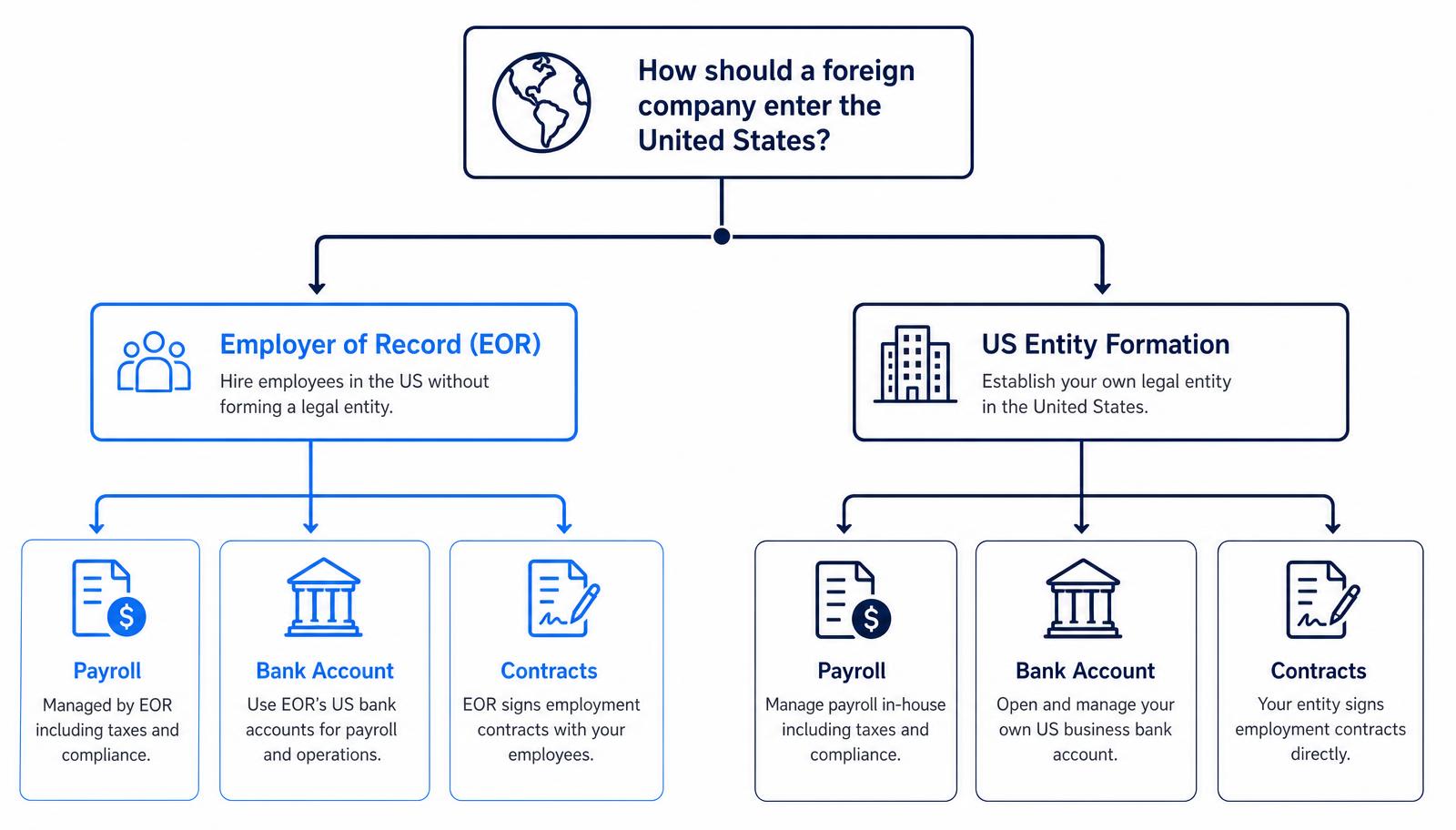
Should a foreign company use an employer of record or form a US entity?
Use an employer of record when you are testing US demand and hiring one to three people quickly — the EOR is the legal employer, so no US entity is required and hiring can happen in days. Move to full company formation in the USA when you pass roughly three to five employees, need your own US bank account for payments or payroll, or must sign US contracts as a US-incorporated counterparty. Formation paperwork takes one to three weeks; the EIN, banking, and state tax registrations that follow are what actually set the ninety-day timeline.
By the Seal Global Editorial Team · August 7, 2026 · Seal Global Holdings has run US market entry and Global Capability Center engagements for global companies expanding into the United States since 2026.
A foreign company entering the US market usually hits the same wall in the first 90 days: it cannot hire a single US employee without either forming a US entity or using an employer of record. That one decision — employer of record vs. entity formation — shapes everything downstream: banking, payroll tax, HR compliance, and how fast the business can actually start selling. This guide walks through both paths, plus the formation, banking, and digital-launch steps that follow.
Typical timeline from decision to first US hire when the entity path is chosen correctly the first time.
Employer of record (no entity required) or US subsidiary/LLC formation (entity required). Most companies pick wrong on the first try because they optimize for setup speed over 12-month cost.
Employer of Record vs. US Entity: Which Comes First?
An employer of record (EOR) lets a foreign company legally employ US-based staff without incorporating anything — the EOR is the employer on paper, handling payroll, tax withholding, and benefits, while the foreign company directs the work day to day. This is the fastest way to make a first US hire, often in days rather than months.
The trade-off: an EOR is a bridge, not a foundation. It works for testing the market with one to five hires, but gets expensive per-employee at scale, and doesn't give the company its own US bank account, US-facing brand entity, or the ability to sign US contracts directly. Modelling that crossover point is a finance question rather than an HR one, which is why most entrants run it past fractional CFO services before committing to twelve months of per-seat EOR fees.
When an Employer of Record Makes Sense
- Testing US demand before committing capital.
- Hiring one to three people while formation and banking are still in progress.
- Avoiding permanent-establishment exposure before that decision is finalized.
When to Move to Full Entity Formation
- Hiring beyond three to five people.
- Needing a US bank account for local payments, payroll, or a merchant account.
- Signing US enterprise contracts that require a US-incorporated counterparty.
Company Formation in the USA
Most foreign companies choose between an LLC and a C-Corp, and between Delaware, Wyoming, or the state where operations will actually run. Formation paperwork typically takes one to three weeks, but the slow parts are what follow: getting an EIN as a foreign-owned entity, opening a US bank account without a US Social Security Number, and state-level tax registration.
LLC or C-Corp for a Foreign-Owned US Business?
An LLC is simpler and pass-through for tax purposes, good for companies not raising US venture capital. A C-Corp is standard if fundraising is planned. Foreign-owned LLCs carry an annual Form 5472 filing requirement with the IRS that applies regardless of US income — the most commonly missed filing for new entrants.
The single most commonly missed annual filing for foreign-owned US LLCs.
US Banking for a Foreign-Owned Company
Opening a US bank account is often the real bottleneck, not incorporation. Most traditional banks require an in-person visit and a US SSN or ITIN for at least one signer. The common workaround: a US-based operations partner or registered agent as the initial point of contact, combined with fintech-friendly business banking platforms that support remote onboarding for foreign-owned entities. Whichever route opens the account, the reconciliation, payroll funding and monthly close behind it usually sit with outsourced accounting services until the US team is large enough to carry them in-house.
HR Compliance and Payroll After Entry
Once hiring moves past the EOR bridge, HR compliance becomes state-specific — wage, overtime, and worker-classification rules vary by state, and misclassifying a contractor as an employee (or vice versa) is one of the costliest mistakes a newly entered company can make. Payroll tax registration has to happen at both federal and state level before the first paycheck. Where a role is genuinely project-shaped rather than permanent, staff augmentation is often the cleaner answer than either an EOR seat or a direct hire.
Brand Strategy and Digital Launch
Entity and banking make a company legally able to operate in the US; brand strategy and digital launch make it findable and trusted by US buyers — a US-facing web presence, Google Business Profile setup where relevant, and messaging adapted for US buying language rather than translated from the home-market site. For product companies that means a US storefront, payments and fulfilment stack built for American buyer expectations, which is the work an ecommerce agency owns. Skipping this step leaves a legally operating US entity that no US customer can find.
A Realistic Timeline
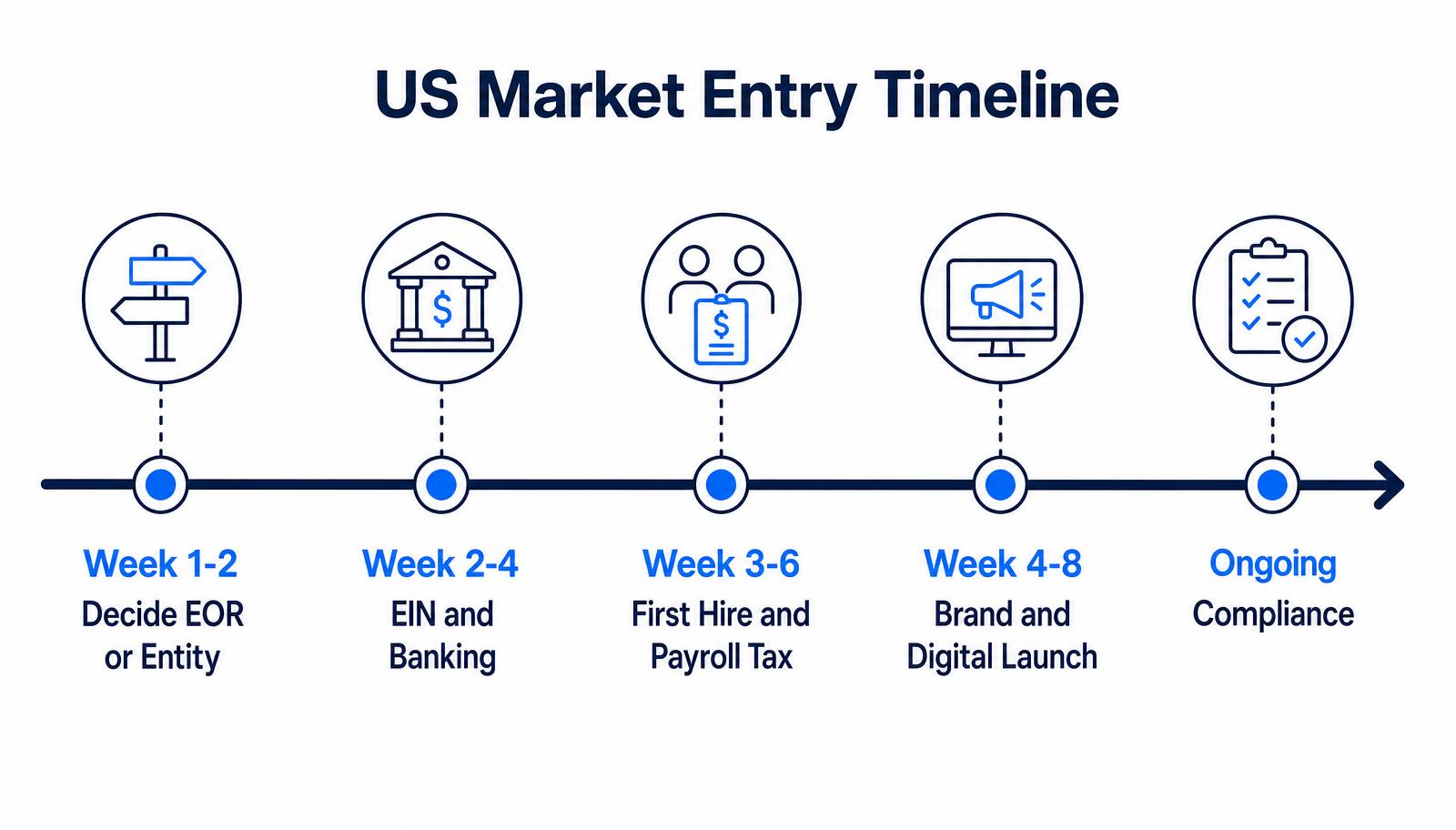
- Week 1-2: decide EOR vs. entity, file formation if entity.
- Week 2-4: EIN application, registered agent, initial banking application.
- Week 3-6: first hire and payroll tax registration.
- Week 4-8: brand and digital launch live.
- Ongoing: state compliance, Form 5472 if applicable, annual reporting.
Running those five tracks in parallel rather than in sequence is what keeps entry inside 90 days, and it is the reason most companies hand the whole sequence to a single US market entry and operations enablement partner instead of coordinating a formation agent, a bank, an EOR and a marketing vendor separately.
Related Reading
Related services from Seal Global
US Market Entry & Operations Enablement
Entity, banking, hiring and launch run as one program.
Learn moreFractional CFO Services
Senior finance leadership to model the EOR vs. entity decision.
Learn moreOutsourced Accounting Services
US bookkeeping, payroll tax and annual filing compliance.
Learn moreStaff Augmentation
Add US-facing capacity without permanent headcount.
Learn moreGlobal Capability Centers
Stand up an offshore operating hub behind your US entity.
Learn moreEcommerce Agency
US-facing digital launch, storefront and demand generation.
Learn moreFrequently asked questions
18 answers about us market entry guide.
1. Entity & Formation
2. Employer of Record & Hiring
3. Banking & Compliance
4. HR, Brand & Costs
Planning a US entry in the next two quarters?
We will map the entity, banking, payroll and launch sequence against your hiring plan — and tell you honestly whether you need an entity yet.
Book a market entry review