
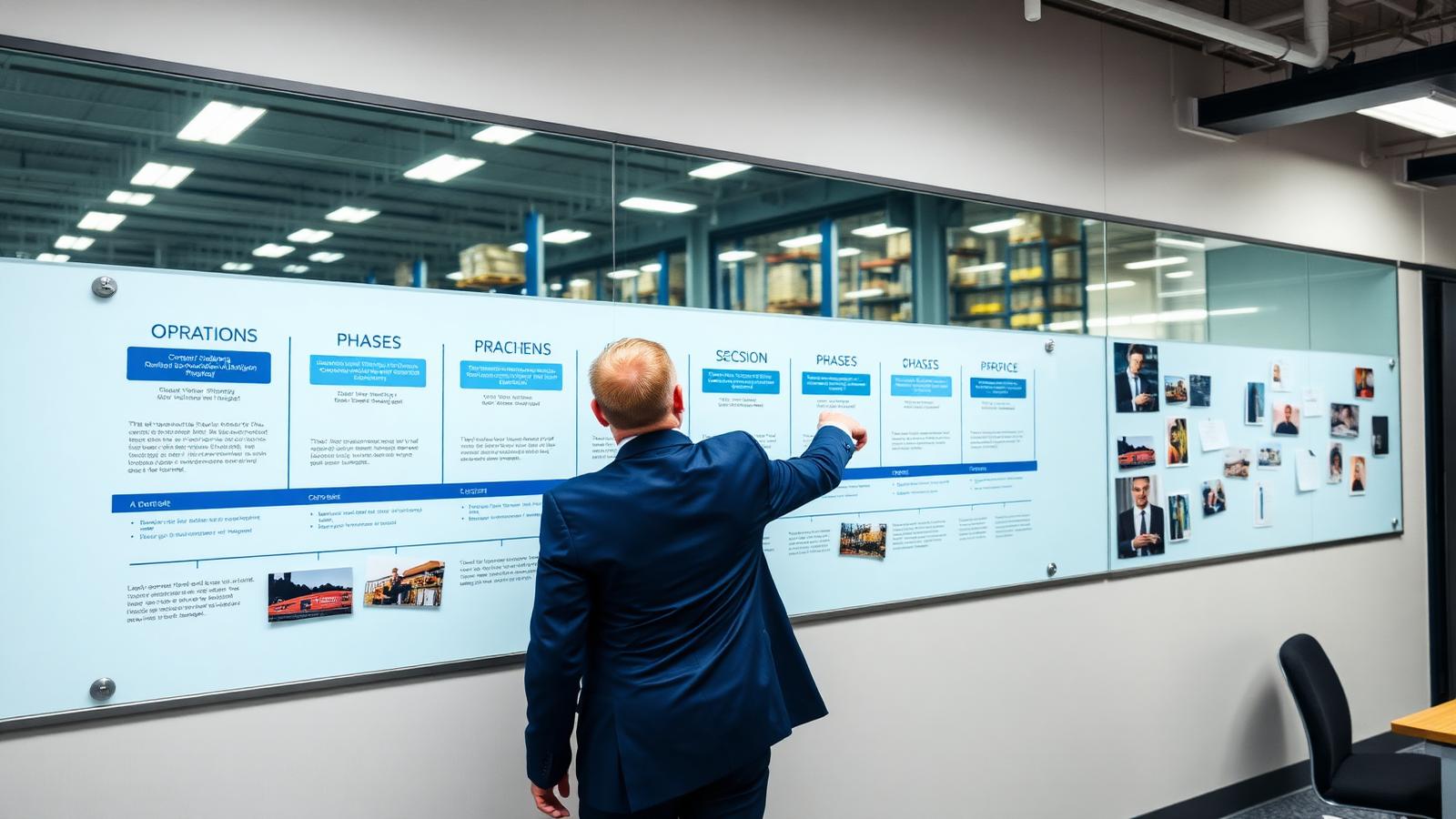
What is the US market entry operations framework?
The US market entry operations framework is the sequence of operational builds a foreign company must complete to trade legally and profitably in the United States: entity and structure, EIN with registered agent and banking, HR payroll or EOR, back-office and accounting, logistics and 3PL for physical goods, customs and product compliance, and finally digital and commercial launch. Each phase unlocks the next.
Most US launches fail on sequencing, not strategy. The market research is sound, the pricing works, the buyers exist — and then the first order cannot be invoiced, the first hire cannot be paid, or the first container cannot clear. What follows is the operational sequence in the order the dependencies actually run, with realistic durations and a clear view of what can be parallelised — the same sequence we run in a US market entry and operations enablement engagement.
What Is US Market Entry Operational Enablement?
US market entry operational enablement is the disciplined build of the infrastructure a foreign company needs to legally transact in the United States — entity, tax identification, banking, employment, accounting, logistics and regulatory compliance. It is distinct from go-to-market strategy: strategy decides what you sell and to whom, while operational enablement determines whether you can accept the order, employ the person and ship the product at all.
Phase 1 — Entity and Structure Decision
Everything downstream inherits this choice. Decide entity type (LLC or C-Corp), structure (subsidiary or branch), formation state, and ownership chain including any intermediate holding company. Get the transfer-pricing intention agreed at the same time, because it determines how revenue and cost sit between parent and US arm for the entity's whole life. Typical duration is one to three weeks of decision plus one to two weeks of filing, handled through US entity incorporation services.
Phase 2 — EIN, Registered Agent and Banking
The EIN is the federal tax identification number that every downstream system asks for: bank, payroll provider, customs broker, payment processor and enterprise vendor onboarding portal. Foreign responsible parties cannot always use the fastest online route, so allow two to six weeks. A registered agent must be appointed in the formation state and in every state you later register in. Banking is the phase most likely to slip: beneficial ownership documentation, apostilled corporate records and, for some banks, an in-person visit. Start banking the day the EIN application is filed, not after it lands.
Phase 3 — HR, Payroll and EOR Setup
Employment is state-by-state, not federal. Every state where an employee sits requires payroll tax registration, unemployment insurance and often workers' compensation, plus state-specific offer terms, notices and leave rules. If hiring must begin before the entity and its registrations exist, an employer of record runs compliant W-2 employment from day one and transfers staff to your entity later. Direct payroll registration takes four to eight weeks per state; EOR onboarding takes days.
Phase 4 — Back-Office and Accounting Setup
This is the phase that gets skipped and then costs the most. It covers the US chart of accounts and its mapping to the parent's consolidation, revenue recognition policy, an order-to-cash process that can issue a US-compliant invoice and collect by ACH, an accounts-payable process with W-9 collection and 1099 reporting, sales-tax nexus monitoring across every state you touch, and a monthly close calendar. Build it before the first invoice, not after the first audit query. Most companies run this through back-office outsourcing for the first two years rather than hiring a US finance team.
Phase 5 — Logistics, 3PL and Warehousing (Physical Goods Only)
Select a 3PL against your actual order profile — units per order, SKU count, returns rate, delivery promise — not against a rate card. Then work through warehouse location versus tax nexus, inventory ownership and consignment terms, WMS integration to your storefront or ERP, SLA definitions with penalties, and returns handling. Allow six to twelve weeks from shortlist to first pick and pack, including integration testing that always takes longer than the provider says.
Phase 6 — Customs, Product Compliance and Registrations
Importing requires an importer of record with a customs bond, correct HTS classification, country-of- origin marking and, depending on the product, agency-specific registration — FDA, FCC, CPSC, EPA or state-level requirements such as California Proposition 65. Labelling and documentation errors are discovered at the port, where the cost is demurrage and a missed launch date. Start this in parallel with Phase 5, never after it.
Phase 7 — Digital and Commercial Launch
Only now does the customer-facing layer make sense: US domain and localisation, payment processing on the US entity, sales tax calculation wired into checkout, US-hours customer support, and the terms, privacy notices and state privacy compliance a US buyer's procurement team will read. Launch demand when the transaction path behind it is complete — which is the entire argument for treating operations enablement as the first workstream rather than the last.
Phase Reference Table: Timeline and Ownership
| Phase | Typical duration | Dependency | Typical owner |
|---|---|---|---|
| 1. Entity and structure | 2–5 weeks | None — start here | Outsourced (Seal Global + counsel) |
| 2. EIN, agent, banking | 3–8 weeks | Requires Phase 1 | Outsourced, parent signatory in-house |
| 3. HR, payroll, EOR | Days (EOR) to 8 weeks (direct) | EOR runs in parallel with Phase 1 | Outsourced; hiring decisions in-house |
| 4. Back office and accounting | 3–6 weeks | Needs EIN and bank | Outsourced, with in-house policy sign-off |
| 5. Logistics and 3PL | 6–12 weeks | Parallel from week one | Outsourced selection, in-house SLA sign-off |
| 6. Customs and compliance | 4–16 weeks by product | Parallel with Phase 5 | Outsourced broker plus regulatory support |
| 7. Digital and commercial launch | 4–8 weeks | Needs Phases 2 and 4 | In-house marketing, outsourced support and billing |
Minimum Viable Setup vs Full Build-Out
A software company selling to US buyers with no physical goods and no US staff can be transactable in about ten weeks with Phases 1, 2, 4 and 7 alone. Add US employees and Phase 3 becomes unavoidable. Add inventory and Phases 5 and 6 add a quarter to the plan. The mistake is not starting small — it is starting small without knowing which phases you deferred, so that the deferred ones surface as emergencies during your first real US quarter.
Related Services from Seal Global
US Market Entry & Operations Enablement
The full seven-phase build delivered as one accountable programme.
Learn moreUS Operations Readiness Assessment
A written phase-by-phase gap analysis with timelines and owners.
Learn moreExpand Operations into the USA
Sequenced entity, compliance and back-office execution for international companies.
Learn moreUS Entity Incorporation Services
Phase one and two: formation, registered agent, EIN and banking support.
Learn moreBack-Office Outsourcing
Order-to-cash, payables, payroll administration and reporting.
Learn moreEmployer of Record & Payroll Compliance
Phase three when hiring must start before the entity is ready.
Learn moreFrequently asked questions
16 answers about us market entry operations framework.
1. Timeline and Sequencing
2. Entity, Banking and Compliance
3. Back Office, Payroll and Logistics
Get your US launch sequenced properly
We will produce a phase-by-phase plan with timelines, owners and dependencies — then build it with you.
Book a launch planning session