
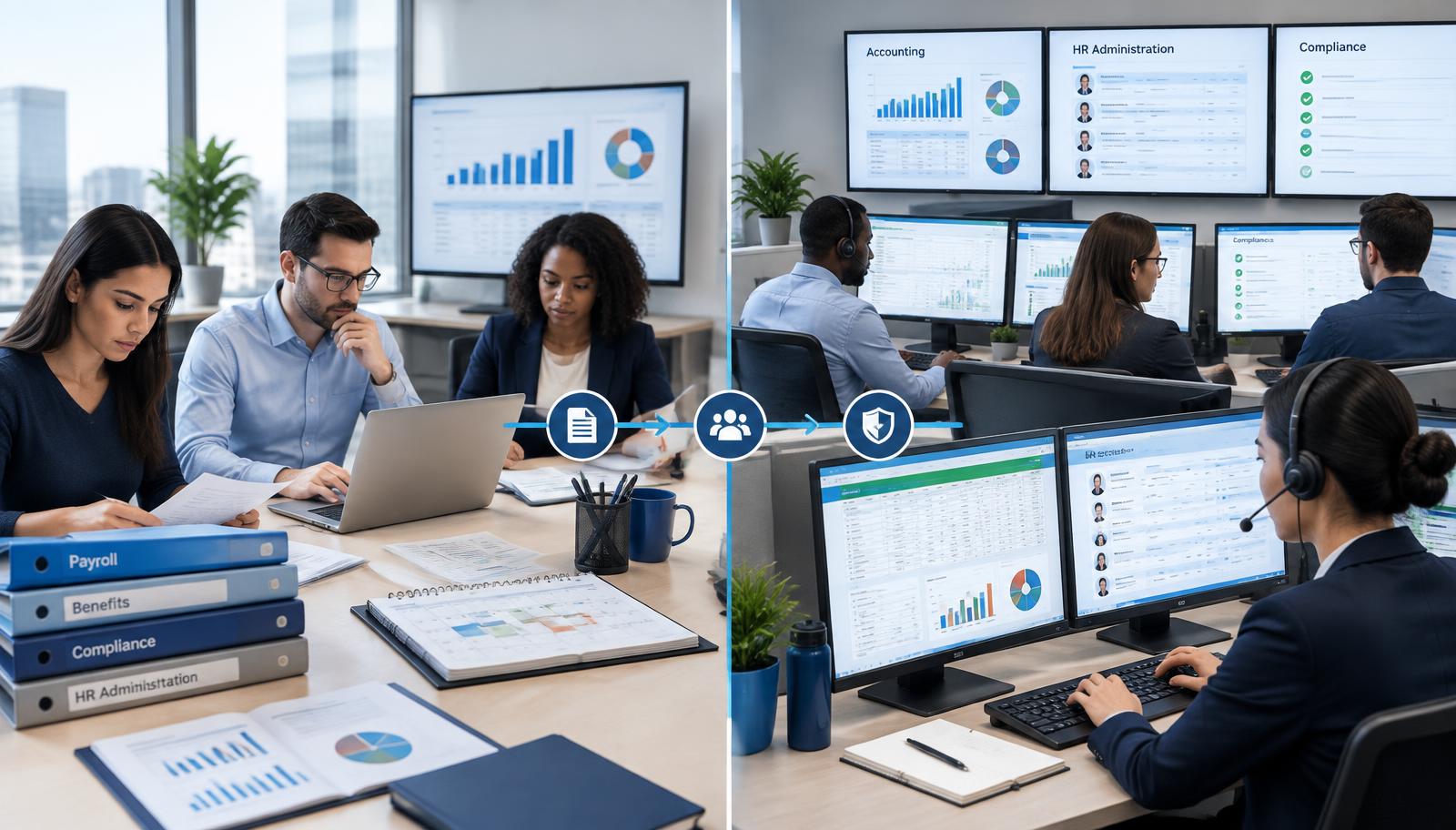
What is an outsourced back-office for a foreign company entering the US?
An outsourced back-office is a managed team that performs a company's recurring US administrative work without becoming its internal staff. It can coordinate accounting operations, payroll administration, compliance calendars, vendor records, invoicing, and employee paperwork while the foreign company retains approvals, policy decisions, and legal accountability.
A foreign company entering the United States needs administrative capacity before it has enough US volume to keep a full team busy. Invoices must be issued, vendors onboarded, payroll inputs checked, state notices answered, and filing dates tracked. The operating decision is whether to hire those capabilities internally or use US back office outsourcing for international companies until the workload supports permanent headcount.
The answer depends on more than salary. Setup time, management capacity, state-level compliance, continuity during absences, and the ability to scale all change the real cost. This comparison treats back office as part of US market entry operations enablement, alongside entity structure, banking, payroll, and compliance rather than as a generic staffing choice.
What Is an Outsourced US Back-Office?
An outsourced back-office is a managed team that performs a company's recurring US administrative work without becoming its internal staff. It can coordinate accounting operations, payroll administration, compliance calendars, vendor records, invoicing, and employee paperwork while the foreign company retains approvals, policy decisions, and legal accountability.
This model is narrower than handing over the entire business. The provider executes defined processes, maintains records, and escalates exceptions. Company officers still approve payments, sign contracts, set employment policy, and own regulated decisions. A sound arrangement separates execution from authority in writing.
In-House Team vs. Outsourced Partner: Reference Table
The figures below are planning ranges, not quotes. Location, seniority, transaction volume, number of states, and the systems already in place can materially change either model's cost.
| Dimension | In-House US Back-Office Team | Outsourced Back-Office Partner |
|---|---|---|
| Setup timeline | Commonly 8–16 weeks to recruit, hire, register payroll, and onboard several roles | Commonly 2–4 weeks for scope, access, controls, documentation, and handover |
| Upfront cost | Recruiting, equipment, software, payroll registration, benefits setup, and management time | Discovery, transition, process documentation, and any system configuration |
| Ongoing monthly cost | Fixed salaries, payroll burden, benefits, software, insurance, and coverage for leave | Retainer, transaction, or capacity pricing that usually expands with scope and volume |
| Compliance and payroll risk | The company owns the risk and must recruit enough federal and multi-state knowledge | Provider manages process and calendars; the company retains legal accountability and approvals |
| Scalability | New capacity requires recruiting or overtime; excess capacity remains a fixed cost | Capacity can be added or reduced under the agreement, subject to notice and service limits |
| US entity required first? | Usually yes for direct employment; state registrations may also be required | Not always for planning and administration; direct payroll and some banking work require an entity or EOR |
| Management model | Direct supervision, internal career paths, and immediate access to company context | Service levels, named process owners, approval matrices, and scheduled reporting |
| Ideal stage or size | Stable US volume, established managers, and enough recurring work for specialist roles | Pre-launch through early scale, uneven volumes, lean local headcount, or multi-state complexity |
Cost: Compare the Operating System, Not One Salary
A fair in-house calculation includes more than an administrator's base pay. A functioning back office may need bookkeeping, AP/AR, payroll administration, HR coordination, compliance tracking, and local management. One generalist can cover parts of that list, but concentration risk appears when that person is absent or leaves. Several specialists solve the coverage problem while raising fixed cost before US revenue has stabilized.
Outsourcing turns much of that fixed capacity into a scoped operating expense. It can be less expensive early because specialists are shared across clients, but pricing must be tested against inclusions, transaction limits, out-of-scope rates, implementation fees, software charges, and notice periods. The right comparison is annual total cost at the required control level, not employee salary versus provider invoice.
Timeline: Outsourcing Usually Starts Faster
Hiring multiple US roles means writing job descriptions, recruiting, interviewing, completing payroll registrations, buying systems, and documenting processes that may not yet exist. An outsourcing partner can begin while entity formation and banking are underway, then connect workflows as those dependencies become available. That sequencing is one reason operations enablement for foreign companies treats administrative design as a pre-launch workstream.
Faster does not mean instant. A provider still needs a signed scope, data-access rules, approval limits, opening balances, filing history, employee information, and a named client-side owner. Promises of a same-day transition usually indicate that discovery and controls have been omitted.
Compliance, Payroll, and EOR Responsibilities
An outsourced back-office partner can prepare payroll inputs, reconcile payroll journals, maintain the compliance calendar, coordinate benefits administration, and collect onboarding records. That does not automatically make the provider the legal employer or transfer every statutory obligation. The contract should state who files, who reviews, who approves, and who is accountable for each federal, state, and local requirement.
When there is no employing US entity, an Employer of Record and payroll compliance service can legally employ staff while the foreign company directs day-to-day work. An outsourced back office supports the records and administration around that arrangement; it is not a substitute for the EOR. Once the company employs directly, payroll registrations, unemployment insurance, workers' compensation, withholding, and labor-law processes move to the entity and its providers.
Scalability and Continuity
Seasonal demand and rapid hiring expose the structural difference between the models. An internal team offers close context and direct control, but capacity changes in whole people and recruiting cycles. A provider can add processing capacity across invoicing, reconciliations, or administrative queues without changing the company's payroll each time. The agreement should define surge limits, response times, and the cost of extra capacity before a peak arrives.
Specialized work may also sit outside the core arrangement. Customer-facing queues belong with customer support outsourcing, while ledgers, close, and reporting belong with outsourced accounting services. Keeping scopes explicit prevents important work from falling between providers.
When an In-House Team Makes More Sense
Internal hiring becomes more attractive when workload is stable enough to occupy specialists, US managers can supervise them, and company-specific judgment dominates routine processing. A business with complex on-site operations, frequent exceptions, sensitive internal approvals, or mature US volume may value proximity and institutional knowledge more than variable capacity.
The change rarely happens at one universal employee or revenue number. Track monthly transaction counts, exception volume, provider fees, internal oversight hours, and the cost of the roles required to replace the service. If internal total cost is lower for a sustained period and the company can maintain coverage and compliance depth, insourcing becomes a rational operating decision.
How to Choose and Preserve a Future Exit
Define ownership before comparing proposals
Build a responsibility matrix covering every recurring process. Name the person who prepares the work, reviews it, approves it, files it, and responds when something fails. Ask prospective providers which states they support, how they protect data, who covers absences, what reports are standard, and how they document changes.
Make portability contractual
The company should own its accounts, records, process documentation, approval history, and exportable data. The agreement should require an orderly handover, current procedure documents, open-item lists, filing calendars, and reasonable transition support. Those provisions allow a future in-house team to take over without rebuilding the control environment from memory.
A Practical Decision Rule
Outsource when US workload is real but uneven, the entity is early, compliance spans unfamiliar states, or speed matters more than building a permanent department. Hire in-house when volumes are stable, management is local, specialist roles can stay fully utilized, and the value of company-specific context exceeds the flexibility of shared capacity. Use a hybrid model when an internal controller or operations lead should own judgment while a managed team handles recurring execution.
Whichever model wins, keep authority, oversight, and access to records inside the company. Managed administrative services for foreign businesses in the US work best when the provider makes execution dependable and the client remains an informed owner of the operation.
Related Reading
- US Market Entry Operations Enablement Services — the complete entity-to-operations program.
- US Shared Services Setup — sequence accounting, payroll, compliance, and administration before launch.
- US Operating Model Review — compare outsourced, in-house, and hybrid ownership.
- Back-Office Outsourcing Services
- 9 Back-Office Functions to Outsource for US Market Entry
- Managed Back-Office Services for Foreign Companies Entering the US
Related services from Seal Global
US Market Entry Operations Enablement
Coordinate entity, banking, payroll, compliance, and back-office work as one operating plan.
Learn moreUS Back-Office Readiness Review
Map the work, owners, systems, and deadlines required before US operations begin.
Learn moreOutsourced-to-In-House Transition Planning
Move recurring work to an internal team without losing controls or filing continuity.
Learn moreBack-Office Outsourcing
Managed administrative support for invoicing, records, vendors, and recurring workflows.
Learn moreEOR & Payroll Compliance
Hire and pay US employees while coordinating state and federal obligations.
Learn moreOutsourced Accounting Services
Bookkeeping, reconciliations, AP/AR, and reporting for US entities.
Learn moreFrequently asked questions
16 answers about in-house and outsourced US back-office operating models.
1. Back-Office Basics
2. Cost & Timeline
3. Compliance, Payroll & EOR
4. Choosing & Switching Models
Choose the model before the workload arrives
Map cost, compliance ownership, and transition points against your actual US operating plan.
Review your back-office model