
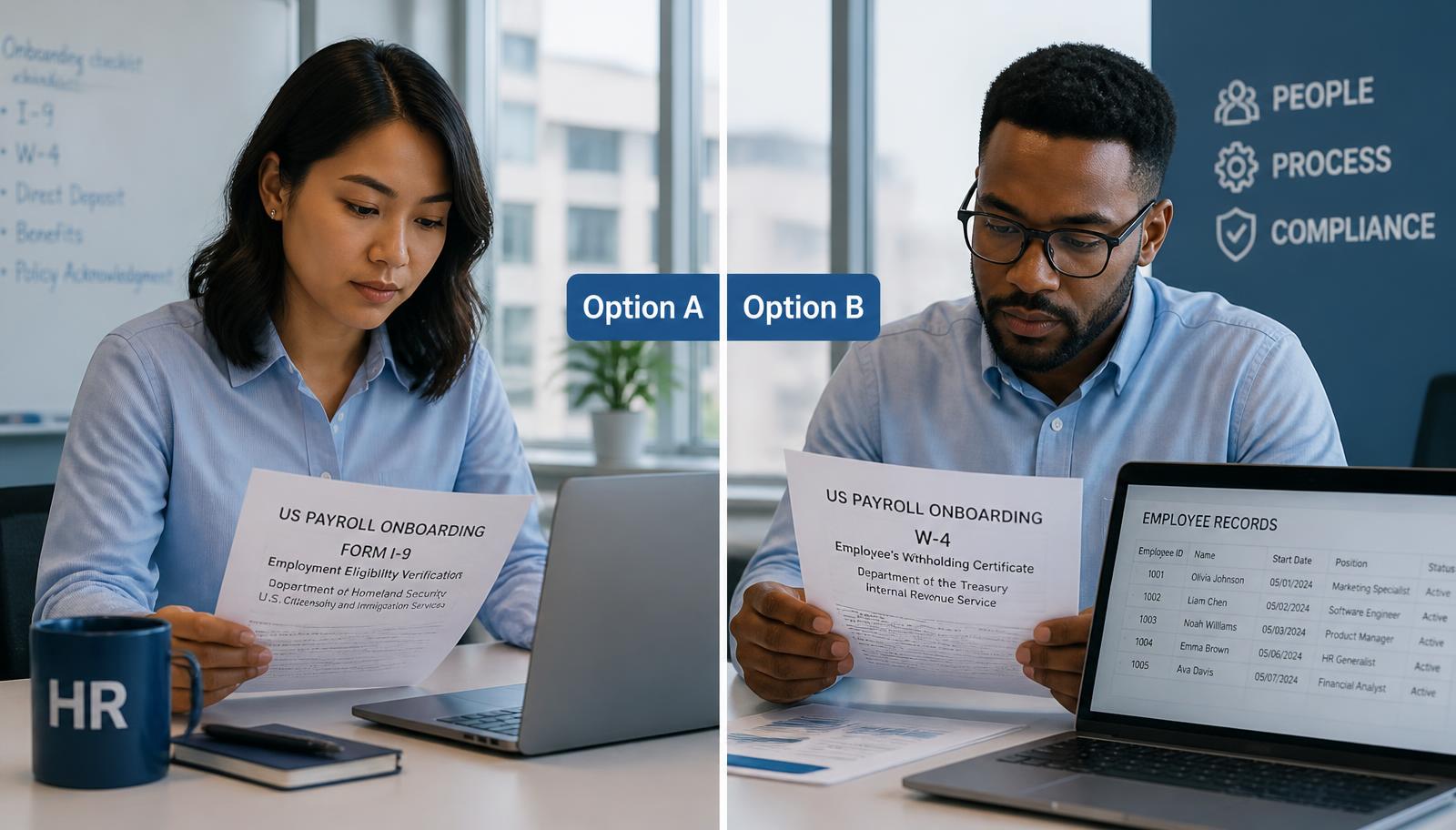
What is the difference between a PEO and an EOR for US hiring?
A PEO co-employs your US staff alongside your own US entity, which must already exist and remain the employer of record for legal purposes. An EOR becomes the legal employer itself, so a foreign company can hire US staff before it has any US entity at all. The practical dividing line is the entity: no US entity means EOR, an existing US entity with growing headcount usually means PEO.
By the Seal Global Holdings Advisory Team, US Market Entry Practice · Published September 14, 2026. Our team runs US payroll, employment compliance and back-office administration for foreign parents across consumer, SaaS, manufacturing and professional services.
Most foreign companies meet these two acronyms in the same week, usually the week a strong US candidate says yes. The comparison gets framed as a vendor choice, which is why it so often produces the wrong answer. PEO and EOR are not competing products at the same stage of a company's life. They answer different questions, and the question a company is actually holding — can we legally pay this person next month — narrows the field immediately.
PEO and EOR, Defined
A PEO (Professional Employer Organization) co-employs your US staff under a contractual arrangement with your existing US entity: you direct the work and remain the employer of record, while the PEO administers payroll, benefits and employment tax filings. An EOR (Employer of Record) instead becomes the legal employer of the worker on your behalf, holding the employment contract and the associated liability, so no US entity of your own is required. The distinction that matters most: a PEO shares employment administration with an employer that already exists, while an EOR supplies the employer.
Everything downstream follows from that line. Because the PEO model presumes a US entity, it also presumes the entity's registrations, EIN, bank account and governance calendar are already in place. The EOR model skips all of it at the cost of holding the employment relationship at one remove from the company the employee thinks they work for.
PEO vs EOR: Side by Side
| Dimension | PEO | EOR |
|---|---|---|
| US entity required? | Yes — the entity must exist, be registered where staff work, and hold its own EIN | No — the EOR's entity carries the employment |
| Legal employer of record | Your entity, with the PEO as co-employer for administration and payroll tax | The EOR, which holds the employment contract and statutory liability |
| Typical cost structure | Percentage of payroll or per-employee administration fee, plus benefits; economics improve with headcount | Flat per-employee monthly fee on top of salary and statutory burden; economics favor small headcount |
| Setup timeline | Gated by entity formation and state registrations first; PEO onboarding itself is fast once those exist | Days to a couple of weeks, because the compliance infrastructure already exists |
| Visa and sponsorship support | Sponsorship runs through your own entity, which is the cleaner posture for petitions | Generally limited; many EORs will not sponsor, and the employer-employee relationship can complicate petitions |
| Best for | Foreign companies with an established US entity and a growing team, wanting benefits scale and one payroll platform | Foreign companies hiring their first few US staff, testing the market, or hiring ahead of incorporation |
Where Foreign Companies Get This Wrong
The common error is treating the EOR stage as permanent. It is excellent infrastructure for one to five people and increasingly awkward beyond that: per-head fees scale linearly, equity grants get complicated, and the sales team's contracts are signed by a company their employer is not. The opposite error is forming an entity in month one because it feels more legitimate, then discovering that the entity brings state registrations, franchise filings and a governance calendar that nobody in the home office has the bandwidth to carry. A structured EOR arrangement exists precisely to defer that cost until the headcount justifies it.
The multi-state wrinkle
US payroll is administered state by state. Each state where an employee physically works generally requires its own withholding and unemployment insurance registrations. Under an EOR, those registrations belong to the EOR and cost you nothing in administration. Under a PEO, they belong to your entity, and a distributed team of six people across five states means five sets of accounts to open and maintain. Companies frequently underestimate this and discover it through a delinquency notice from a state agency.
What conversion actually involves
Moving from an EOR to your own payroll is ordinary work, not a rescue operation: employees are terminated from the EOR and rehired by your entity on a chosen date, benefits are re-enrolled, and accrued balances are settled. Done deliberately, the employee sees a new pay stub and nothing else. Done reactively, it lands mid-quarter and produces duplicate wage reporting. Planning the conversion date before the first EOR hire, and keeping the accounting function aligned to it, removes almost all of the difficulty.
Choosing, in Practice
Start from three facts: whether a US entity already exists, how many people you expect to employ in twelve months, and whether any of them will need visa sponsorship. No entity and fewer than about five hires points to an EOR, with an entity formed in parallel if other operations — banking, imports, contracts — require one anyway. An existing entity with a dozen people points to a PEO or direct payroll. Sponsorship needs point toward your own entity sooner than headcount alone would suggest. We sequence those decisions as part of a US market entry operations program rather than as an isolated HR procurement, because the hiring model determines what the entity has to be ready for and by when.
Related services from Seal Global
US Market Entry & Operations Enablement
Entity, banking, payroll and back-office sequenced as one program.
Learn moreEmployer of Record & Payroll Compliance
Hire and pay US staff before or alongside your own entity.
Learn morePlan Your US Hiring Sequence
A working session on when to move from EOR to your own payroll.
Learn moreOutsourced Accounting Services
US books, payroll journals and state tax accounts kept current.
Learn moreBack-Office Outsourcing
Payables, receivables, payroll administration and reporting under one team.
Learn moreUS Entity Incorporation Services
Formation, EIN and state qualification when the EOR stage ends.
Learn moreFrequently asked questions
16 answers about peo vs eor.
1. PEO & EOR Basics
2. Legal & Entity Implications
3. Cost & Timeline
4. Choosing the Right Model
Hire first, then build the entity around the team
We run the EOR stage, form the entity when headcount justifies it, and migrate payroll without a gap in coverage.
Talk to our US market entry team