
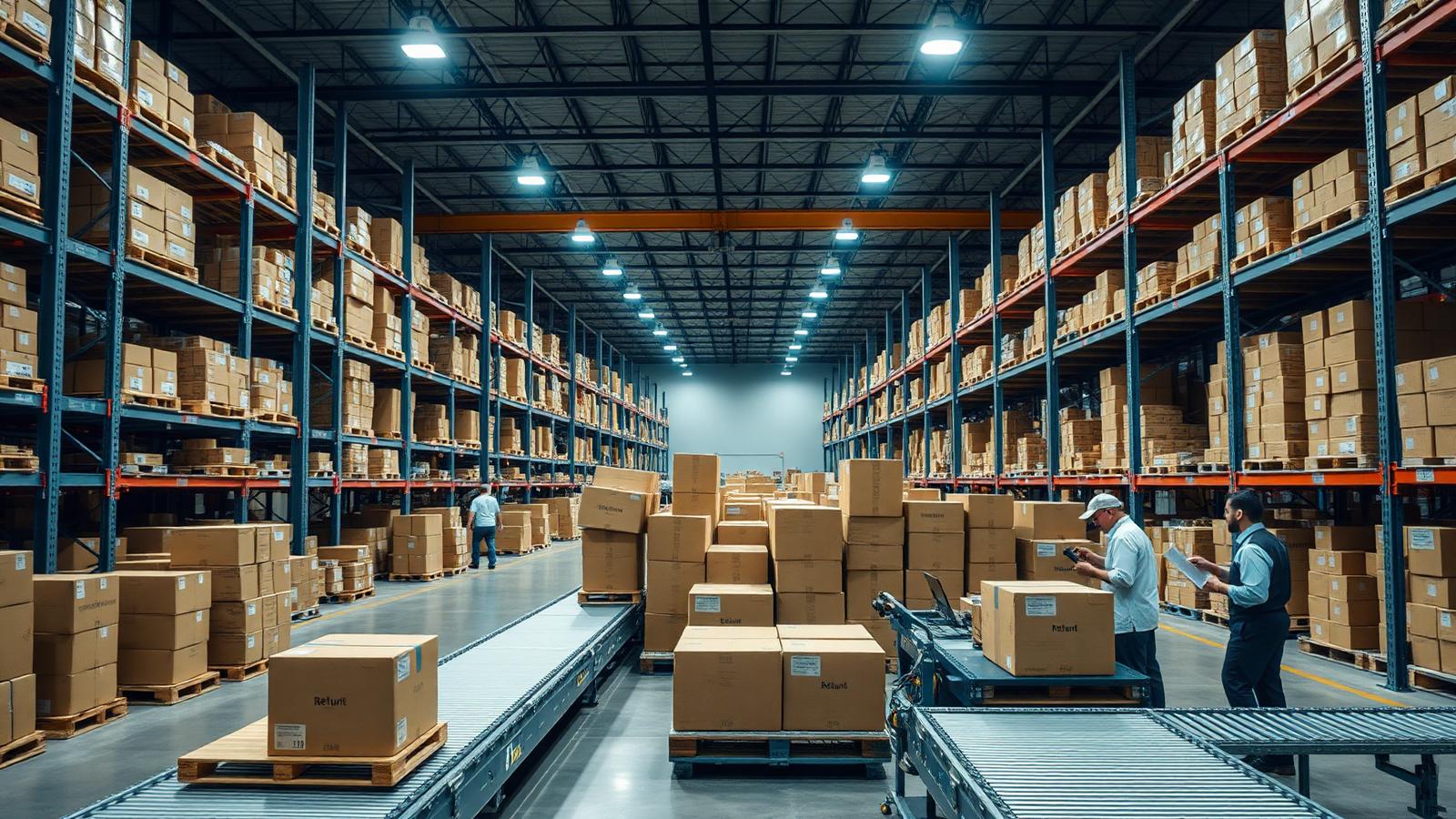
What does a foreign e-commerce brand need to set up US fulfillment and returns?
US fulfillment and reverse-logistics setup requires ten operational building blocks: a 3PL or owned-warehouse decision, bonded or general storage, an importer-of-record and customs clearance route, inventory and order-management integration, a documented returns workflow, state tax registration where inventory sits, cargo and warehouse-legal-liability insurance, last-mile carrier contracts, returns fraud controls, and a peak-season scaling plan. Each is a dependency of the next, and inventory stored in a US state creates tax nexus for the brand, not the warehouse operator.
Foreign e-commerce brands rarely fail in the US because the product is wrong. They fail because inventory sits in customs, returns pile up unprocessed in a corner of a third-party warehouse, and a state tax notice arrives six months after the first pallet landed. Fulfillment and reverse logistics are operational infrastructure, and infrastructure has to be built in order. Here are the ten requirements, in the sequence we build them for clients through our US market entry and operations enablement practice.
What Is US Fulfillment and Reverse Logistics Setup?
US fulfillment and reverse-logistics setup is the build-out of the physical and administrative system that moves a foreign brand's goods into the United States, out to customers, and back again: import clearance and importer-of-record status, storage in a 3PL or owned warehouse, order and inventory system integration, carrier contracts, and a documented returns and refurbishment workflow. It is an operations-enablement discipline — the goods cannot legally or practically flow until entity, tax registration, customs bond and warehouse contracts are all in place.
1. Decide Between a 3PL and an Owned Warehouse
Almost every first-time entrant should start with a 3PL. An owned or leased facility means a multi-year lease, a warehouse management system, racking capex, a hired workforce, workers' compensation insurance in that state, and an operations manager on the ground before you have volume to justify any of it. A 3PL converts all of that into a per-unit cost you can exit.
| Factor | 3PL | Owned / Leased Warehouse |
|---|---|---|
| Time to first shipment | 3–8 weeks (contract, integration, first inbound) | 4–9 months (site search, lease, fit-out, hiring) |
| Upfront capital | Setup fee plus inventory; minimal capex | Racking, MHE, WMS, deposits — six figures is common |
| Cost structure | Variable: receiving, storage, pick/pack, per-return fees | Largely fixed: rent, payroll, utilities regardless of volume |
| Control over process | Limited; SOPs negotiated, exceptions cost extra | Full control over packing, QC, refurbishment, branding |
| Returns handling | Basic grading only unless you pay for value-added services | Custom grading, repair and restock workflows possible |
| Employment footprint | None — 3PL employs the labour | State payroll registration, workers' comp, HR compliance |
| Tax nexus effect | Your inventory still creates nexus in that state | Nexus plus property and payroll factors |
| Best for | Launch through roughly 5,000–20,000 orders/month | Stable high volume, heavy customisation or regulated goods |
2. Establish Importer-of-Record Status and a Customs Bond
Someone must be the importer of record (IOR) on every US entry — legally responsible for classification, valuation, duty payment and record retention. Foreign brands often lean on a supplier or a freight forwarder in the first shipments and then discover they cannot claim duty refunds, cannot prove compliance in an audit, and have no continuous bond of their own. Your US entity should be the IOR, with a continuous customs bond, an assigned HTS classification set, and a licensed customs broker under a power of attorney.
3. Decide Whether You Need Bonded or Foreign-Trade-Zone Storage
A bonded warehouse or FTZ lets you defer duty until goods leave for a US customer, and avoid it entirely on goods that are re-exported. That matters if you hold high-duty inventory, distribute into Canada and Latin America from a US hub, or carry long-tail stock. For most DTC brands with fast-turning inventory, standard 3PL storage is simpler and cheaper — bonded facilities add recordkeeping obligations and fewer provider choices.
4. Design the Returns and Reverse-Logistics Workflow Before Launch
Reverse logistics is the requirement most brands leave until the first refund request. Define, in writing and in the 3PL contract: the RMA authorisation route, the returns address and whether it differs from the outbound facility, prepaid label policy, inspection and grading criteria, restock versus refurbish versus liquidate versus destroy decision rules, the SLA from receipt to refund, and who bears the cost of each path. US shopper expectation is a refund within days of the carrier scan, not days after your warehouse gets around to grading.
5. Integrate Inventory and Order Systems
Your storefront, ERP or OMS, the 3PL's WMS and your accounting ledger must agree on stock. Confirm real-time or near-real-time inventory sync, order and tracking write-back, support for bundles and kits, batch or lot and serial tracking if you need recall traceability, and a returns event that flows back into both inventory and the finance ledger. Reconciling landed cost and inventory value is where our outsourced accounting team most often finds six-figure discrepancies in year one.
6. Register for Tax in Every State Where Inventory Sits
Storing goods in a state generally creates physical nexus for the brand — not for the 3PL. That triggers sales tax registration, collection and filing obligations, and often income or franchise tax exposure. If you use a distributed fulfilment network or a marketplace's warehouses, your inventory may be spread across a dozen states without you selecting any of them. Ask for the inventory-location report before you sign, and register before your first sale ships from each state.
7. Insure the Goods Properly
A 3PL contract almost never makes the provider a full insurer of your stock; liability is usually capped at a small amount per pound or per pallet. You need your own cargo and marine coverage for transit, stock-throughput or warehouse-legal-liability coverage for stored goods, and product liability coverage naming your US entity — which US retailers and marketplaces will ask to see as a certificate of insurance before onboarding you.
8. Contract Last-Mile Carriers Deliberately
Do not simply inherit your 3PL's rate card. Understand which carrier mix serves your zones, the dimensional weight rules that will reprice your packaging, residential and fuel surcharges, peak season surcharges announced each autumn, and the service level your product actually needs. Packaging redesign is often the highest-ROI logistics change a foreign brand makes in its first US year.
9. Build Returns Fraud and Abuse Controls
US returns abuse — wardrobing, empty-box returns, serial refund claims, receipt-free returns — is materially higher than in most home markets. Controls include serial or unique-code verification on high-value SKUs, inspection photography at receipt, per-customer return-rate monitoring, a documented policy for denying refunds, and clear chargeback evidence packs. Your support team needs the same evidence, which is why the returns workflow and the customer support function should be designed together rather than sequentially.
10. Plan for Peak-Season Scaling
Peak is not just more orders; it is receiving cut-offs, carrier capacity caps, labour shortages at the 3PL, and a January returns wave that can hit 20–30% of holiday volume in apparel. Contract peak capacity in writing during the summer, agree receiving appointments for inbound containers, forecast returns labour separately from outbound, and pre-agree the surcharge schedule.
The Sequence That Actually Works
Entity and EIN, then customs bond and IOR, then 3PL contract and system integration, then state registrations, then insurance and carrier contracts, then returns workflow, then peak plan. Skipping ahead is what produces detained containers and unregistered nexus. If you want the whole chain run as one program alongside entity, banking and payroll, that is exactly what our operations enablement service for US market entry is built to do, and it pairs with our broader US expansion support for brands that have not yet incorporated.
Related Services from Seal Global
US Market Entry & Operations Enablement
Entity, customs, warehousing and back office sequenced as one program.
Learn moreLaunch US Fulfillment Operations
3PL selection, importer of record and returns workflow design.
Learn moreBack Office Outsourcing
Order administration, reconciliation and returns exception handling.
Learn moreExpand Your Business to the USA
The full operational path from foreign HQ to US trading entity.
Learn moreCustomer Support Outsourcing
US-hours support teams handling WISMO, RMA and returns queues.
Learn moreOutsourced Accounting Services
Sales tax registration, filings and landed-cost accounting.
Learn moreFrequently asked questions
17 answers about us fulfillment & reverse logistics.
1. 3PL, warehousing and network design
2. Customs, compliance and tax exposure
3. Returns and reverse logistics
4. Systems, insurance and scaling
Get your US fulfillment stack right before peak
We map 3PL selection, importer-of-record setup, returns workflow and state registrations against your launch date.
Book a fulfillment readiness review