
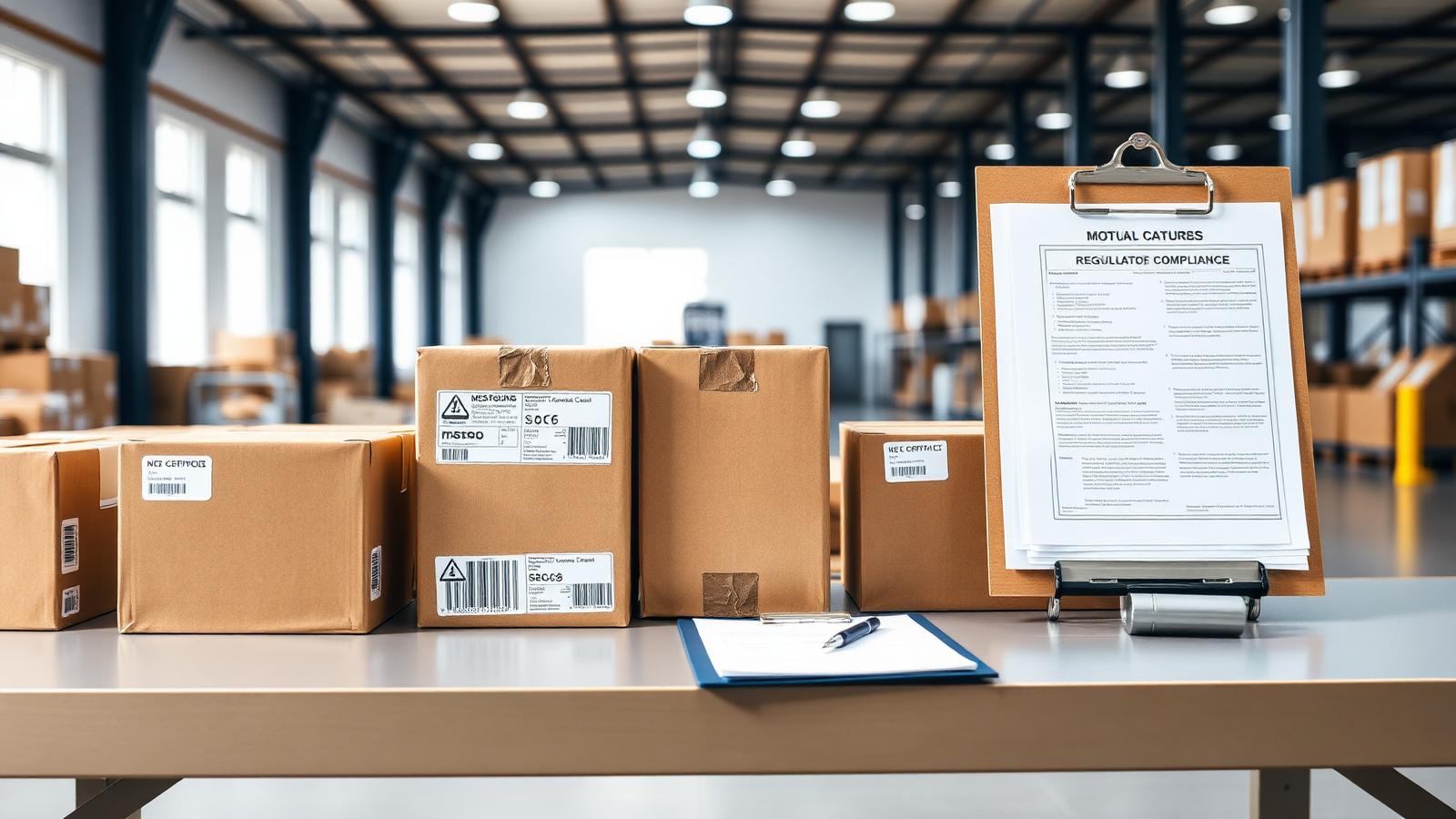
What is US product compliance for foreign brands?
US product compliance is the set of federal regulatory requirements a product must satisfy — agency approval or registration, testing and certification, and US-specific labeling — before it can lawfully be imported and sold in the United States. Which agency applies depends on the product: FDA for food, supplements, cosmetics and medical devices; CPSC for consumer goods and children's products; FCC for electronics that emit radio frequency; USDA for agricultural items.
By the Seal Global Editorial Team · August 25, 2026
Written by the team that prepares import documentation, labeling files and agency registrations for foreign brands entering the US market.
Most foreign brands treat entering the US as a logistics problem: find a freight forwarder, appoint a 3PL, book a container. The shipment then sits at the port because the product itself was never cleared — the label is missing a US-format nutrition panel, the electronics have no FCC equipment authorization, the children's product has no test certificate. US product compliance is a separate workstream from freight, and it starts months earlier. It is one of the first things we scope inside US market entry operations enablement engagements.
What Is US Product Compliance for Foreign Brands?
What is US product compliance? US product compliance is the set of federal regulatory requirements a product must satisfy — agency approval or registration, testing and certification, and US-specific labeling — before it can lawfully be imported and sold in the United States. Which agency applies depends on the product: FDA for food, supplements, cosmetics and medical devices; CPSC for consumer goods and children's products; FCC for electronics that emit radio frequency; USDA for agricultural items. Customs clearance checks that this compliance already exists; it does not create it.
That last sentence is the one brands most often misunderstand. US Customs and Border Protection acts as the gatekeeper for other agencies. A customs broker files your entry, but the broker does not make your product compliant — they declare that it is. If the underlying registration, certificate or label does not exist, the entry is refused, and the goods sit in bonded storage accruing charges.
Which US Agency Regulates Your Product?
The table below maps common product categories to the agency that governs them, the documentation typically required, and realistic planning timelines. Treat the timelines as planning ranges, not guarantees — they vary by product complexity, testing lab capacity and agency backlog.
| Product Category | Primary US Regulator / Standard | Typical Required Documentation | Planning Timeline |
|---|---|---|---|
| Food & beverage | FDA (facility registration, FSMA) | Facility registration number, US agent appointment, Prior Notice per shipment, US nutrition and allergen labeling | 8–16 weeks |
| Dietary supplements | FDA (DSHEA labeling rules) | Supplement Facts panel, permitted claims review, facility registration, ingredient substantiation file | 10–20 weeks |
| Cosmetics & skincare | FDA (MoCRA) | Facility registration, product listing, responsible person on label, safety substantiation | 8–14 weeks |
| Medical devices | FDA (device classification) | Class determination, 510(k) where applicable, establishment registration, UDI labeling | 6–18 months |
| General consumer goods | CPSC | General Certificate of Conformity, third-party test reports where required, tracking label | 4–10 weeks |
| Children's products & toys | CPSC (CPSIA, ASTM F963) | Children's Product Certificate, accredited third-party lab testing, permanent tracking label | 6–12 weeks |
| Electronics & wireless devices | FCC (Part 15 / equipment authorization) | SDoC or Certification via a Telecommunication Certification Body, FCC label, test report | 6–14 weeks |
| Textiles & apparel | FTC labeling rules; CPSC flammability | Fiber content, country of origin and care labeling; RN number optional; flammability compliance | 3–8 weeks |
| Agricultural & plant-derived goods | USDA / APHIS | Import permit, phytosanitary certificate, treatment records | 6–16 weeks |
| All categories (customs layer) | CBP | HTS classification, commercial invoice, packing list, bill of lading, importer of record bond | 2–4 weeks to establish |
The Six Steps to Import Regulatory Clearance
- Classify the product. Determine the HTS code and, from it, the duty rate and which partner government agencies flag the entry.
- Identify the governing agency and standard. One product can trigger two — a connected kitchen device answers to both CPSC and FCC.
- Complete testing and certification with an accredited laboratory and retain the reports; CPSC and FCC both expect them on demand.
- Rebuild the label for the US market. Units, claims, country of origin, responsible-party address and required panels are all US-specific.
- Establish the importer of record. A US entity, an EIN or CBP-assigned number, and a continuous customs bond. Formation of that entity is handled through US entity incorporation services.
- Brief your broker and 3PL. Give them the classification, certificates and labeling spec before the first container is booked, not after it lands.
Why Labeling Fails More Often Than Testing
In our experience the product itself usually passes. The label is what fails. Metric-only measurements, an EU-style ingredient list, a health claim that is legal in the UK but a drug claim in the US, a missing "Distributed by" line — each is enough to stop an entry. Rebuilding artwork after production is expensive; specifying US artwork before the production run is nearly free. Brands that plan a US launch alongside their wider expansion into the USA usually get one set of artwork approved for both markets.
Customs brokers versus compliance advisors
A customs broker is licensed to file entries and is paid per shipment. A compliance advisor determines what your product must satisfy before any shipment exists. Both are necessary; neither replaces the other. Where a broker will tell you an entry was rejected, a compliance advisor tells you months earlier why it would be.
What Non-Compliance Actually Costs
A detained shipment generates demurrage at the port, per-diem container charges, bonded warehouse storage, and re-export or destruction costs if the refusal stands. Add the lost launch window and the retailer relationship damaged by a missed delivery date. Repeat refusals also place the importer on heightened scrutiny lists, which slows every subsequent entry. The cost of getting compliance right before the first shipment is almost always a fraction of one detention.
Where this sits in the wider operations picture
Product compliance connects to almost everything else in a US launch: the entity that acts as importer of record, the bank account that pays duty, the accounting treatment of duties and landed cost, and the 3PL that applies compliant labels at receipt. Keeping duty and landed-cost accounting clean from day one is straightforward with outsourced accounting services in place, and messy to reconstruct later. Document control, supplier certificates and audit-ready filing are the sort of recurring admin we absorb through back office outsourcing.
What to Prepare Before Your First Shipment
- Full product specification, bill of materials and supplier certificates
- Draft US artwork with all required panels and claims reviewed
- HTS classification opinion and landed-cost model
- Accredited test reports and the applicable certificate of conformity
- US importer of record entity, EIN and continuous customs bond
- 3PL receiving instructions covering any relabeling at the door
Brands that arrive with that folder complete clear customs on the first attempt. Brands that arrive without it learn the requirements at the port. If you want the folder built for you, our operations enablement team assembles it alongside your entity, banking and logistics setup so the launch date holds.
Related Services from Seal Global
US Market Entry Operations Enablement
Entity, compliance, logistics and back-office run as one workstream before your first shipment.
Learn moreImport & Customs Operations Support
Classification, documentation and broker coordination handled end to end.
Learn more3PL & Warehousing Setup
Receiving, labeling and fulfilment configured around your compliance obligations.
Learn moreBack Office Outsourcing
Document control, supplier records and filing discipline for regulated imports.
Learn moreUS Warehousing & Customs Setup Checklist
The physical infrastructure side of getting goods into the US.
Learn moreExpand Your Business to the USA
Everything needed to set up and run a US business, under one roof.
Learn moreFrequently asked questions
17 answers about us product compliance.
1. Compliance Basics
2. Documentation & Process
3. Cost & Risk
4. Getting Started
Clear your product before it clears customs
We map the agencies, documents and labeling your product needs, then run the process with your broker and 3PL.
Book a compliance review